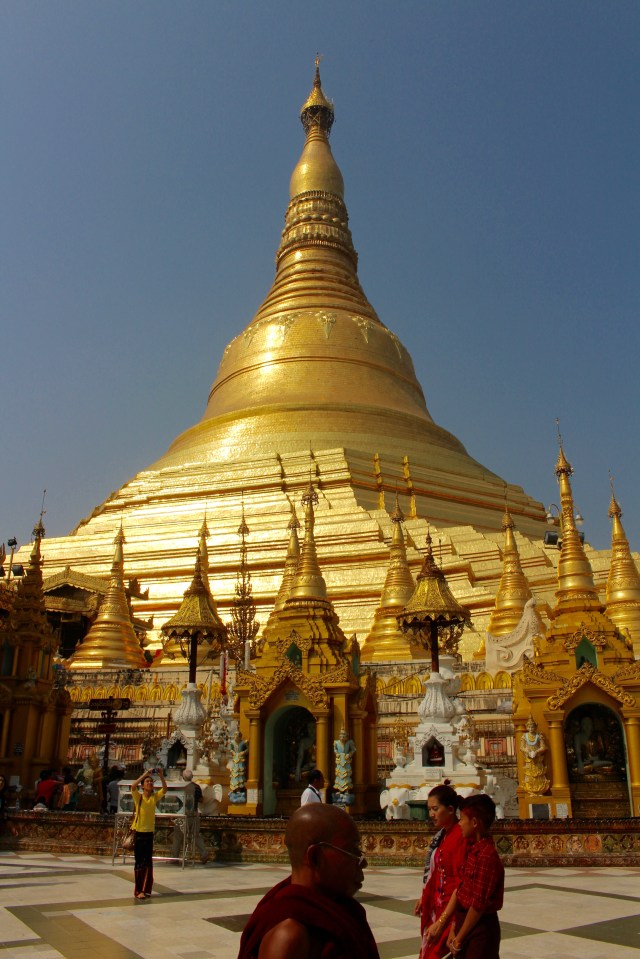
The crown jewel of Yangon is Shwedagon Pagoda, a gigantic gilded stupa centered in a big plaza of pagodas and temples, at the top of the highest hill in Yangon. The back of our entrance ticket (only foreigners pay, 8,000 kyat = ~$6.50) said that top of the stupa is tipped with 5,448 diamonds and 2,317 rubies, and the very top—the diamond bud—is a 76 carat diamond. It is an impressive sight, with grandiose entrances at each cardinal direction. We entered from the east, and departed that way as well, so Aleksiy could return the borrowed longyi he was asked to wear.
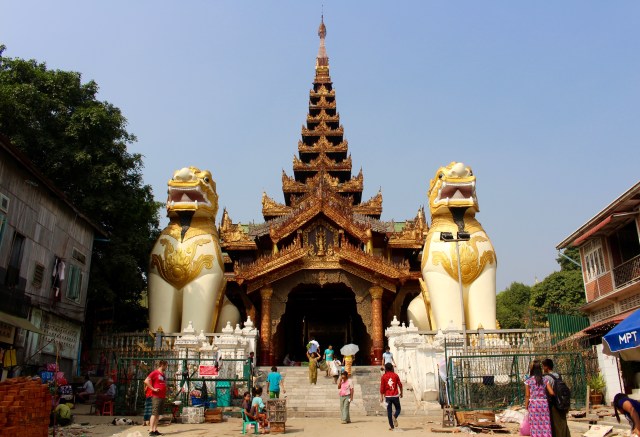
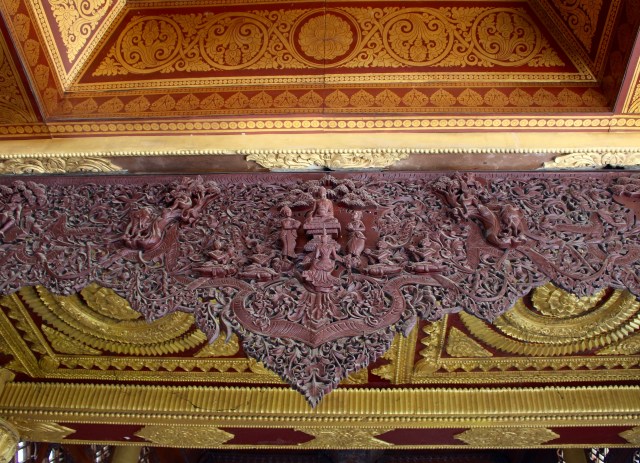
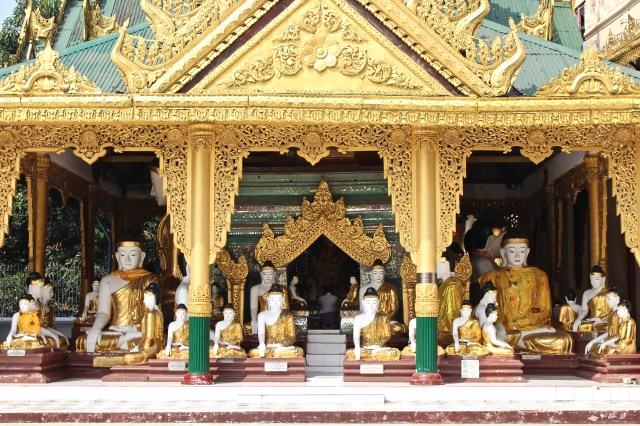
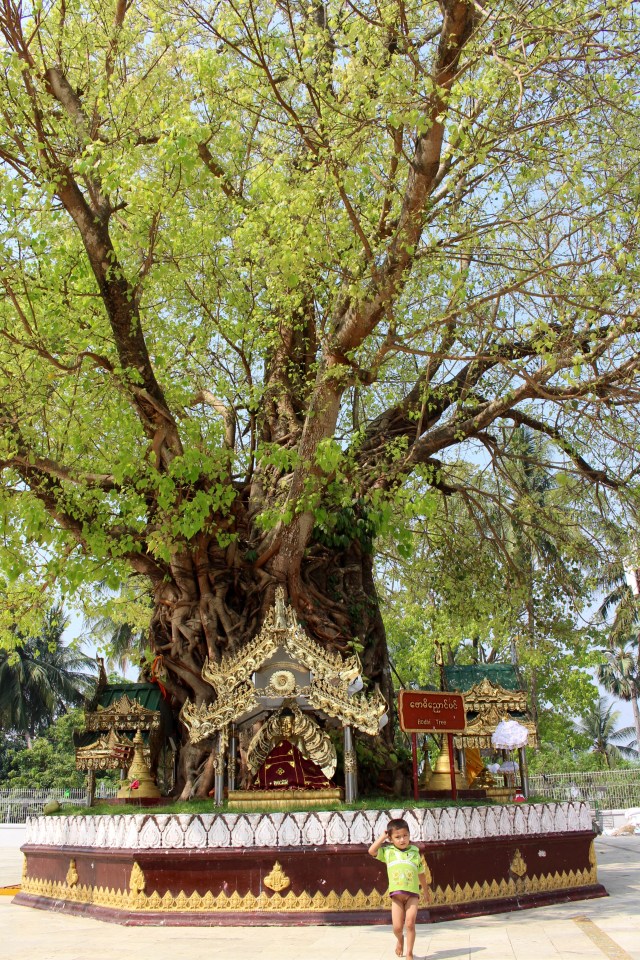
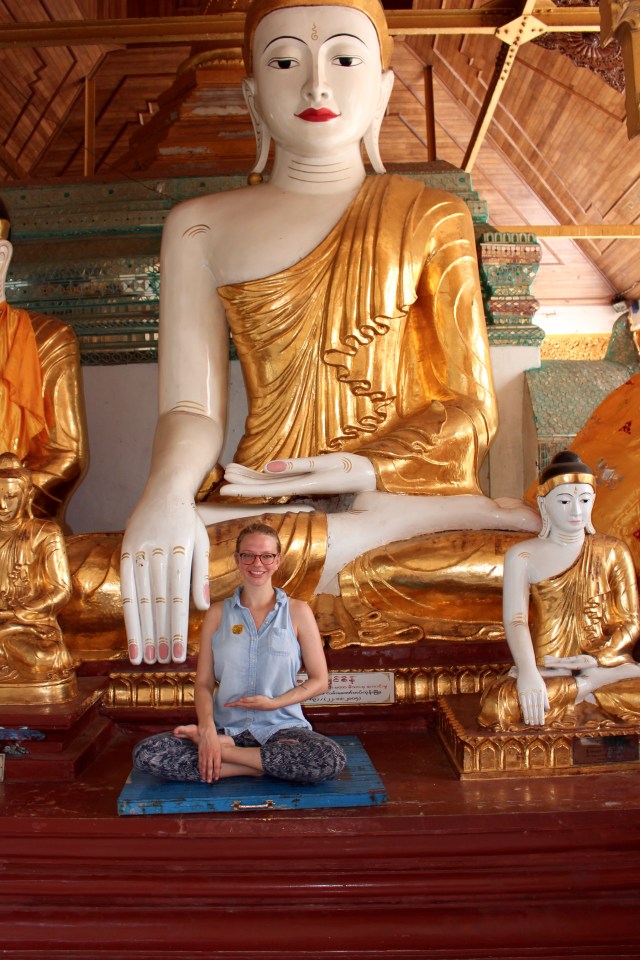
East entrance – two city blocks below the plaza, you walk up two long sets of stairs to get to the topInside the multi-roofed hall is the second set of stairs you walk up to enter the plaza at the topOrnate carvings hung at intervals from the ceiling of the eastern entrance hall. Tons of merchants lined the hall, selling everything from malas, candles, and strings of flowers to live caged birds for people leave behind as offerings within the temples in the plaza.Inside the plazaAn entrance to one of the many pagodas in the plazaA sacred Bodhi Tree growing in the plaza. Buddhists believe that Siddharta Gautama attained enlightenment under a Bodhi tree (becoming Buddha) and now these trees are planted near every Buddhist monastery. This little half naked boy acted as our unofficial tour guide for a good 20 minutes or so – pulling us around pointing at things. No idea who he belonged to or why he had no pants on, but he didn’t seem lost or scared so I let him get on with his pooh bear swag.Reclining Buddha and a smaller golden Buddha surrounded by monks in one of the pagodasOh hey, just sittin how I always sit.Get a load of that sweet dragon… or chinthe …or leogryph….
Every holy place we’ve visited has requested that we leave our shoes+socks at the entrance and wear clothing that covers our knees and most of our shoulders. We are more than happy to oblige out of respect for holy places and worshiping Buddhists, but the heat (over 100F), hot stone, and lack of viable wardrobe options doesn’t make it easy. Aleksiy thought he could get by with his shorts, but alas, his big white knees betrayed him again -they are always getting him into trouble. I’m not going to say the highlight of the day was watching him sashay through the plaza, but it was truly a sight to behold.
We spent the first full day wandering towards/by/thru interest points in downtown Yangon. It was hotter than hell, at one point we let our HANGER get the best of us, but it felt amazing to get lost in such a bustling, different city.
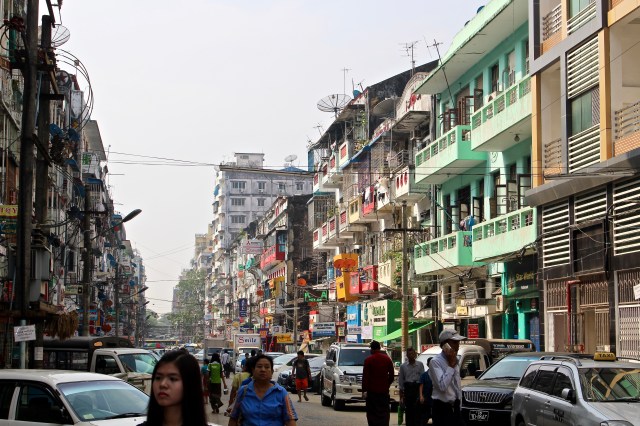
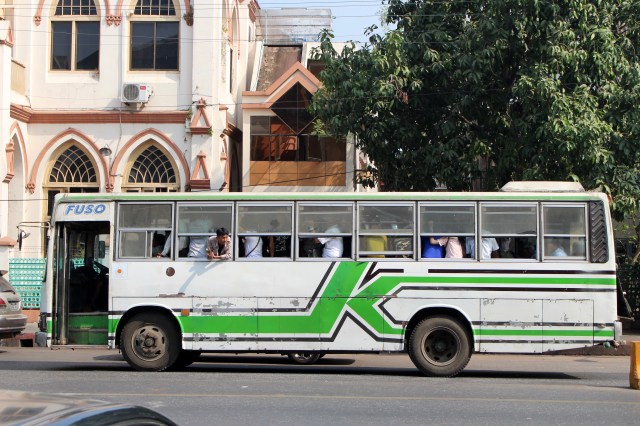
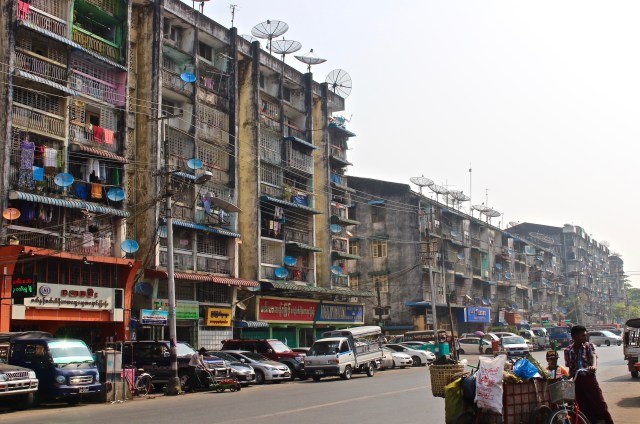
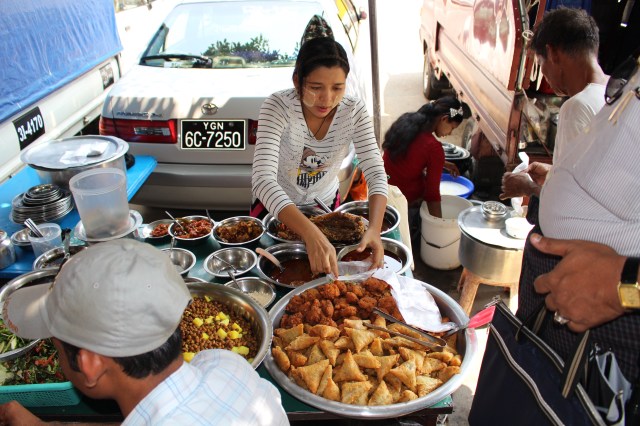
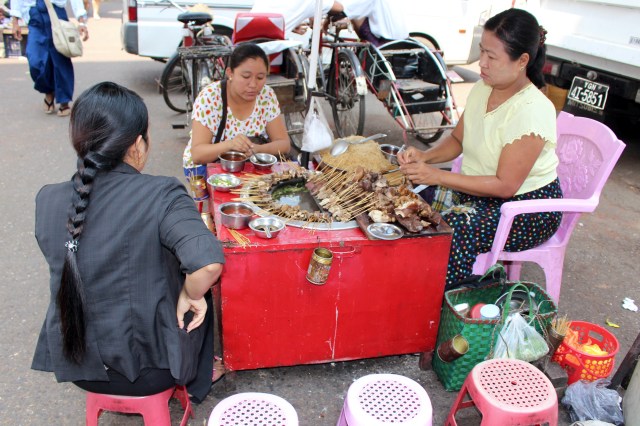
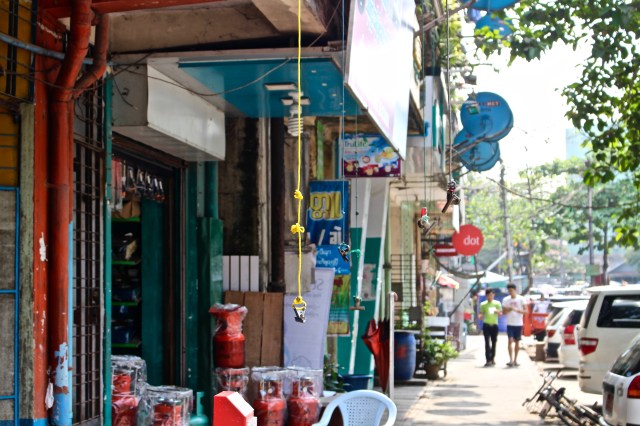
Mini-monks on their morning alms route. “Every Buddhist Burmese boy between the age of 7 and 13 is expected to enter the monastery as a novice monk for a period of a few weeks to several months. He has a choice to return to life outside the monastery at any time, or he can stay on as a monk, if he so chooses.” Read more on monks of Myanmar hereTypical side street in downtown YangonLocal BusA look down Anawrahta RoadThere were stands like this on every corner. The man takes a betel leaf, brushes slaked lime on it (limestone heated & mixed with water), adds some crushed betel nut, tobacco and other spices such as cinnamon or nutmeg, whatever the customer orders. He then wraps the leaf into a bitesize little packet so that the consumer can chew it like chewing tobacco. Something in it turns their saliva and teeth a muddy red color, and they have to spit a lot. The first time I saw it I thought people were spitting blood. It’s very common, said to give the user tons of energy , but also extremely carcinogenic. We passed on it. Read more on betel nut hereTypical food vendor – the samosas were a favorite of ours because most were meat-free (read: safe) and stuffed with flavorful potatoes, peas, sometimes minced onion. The vendor is wearing thanaka on her cheeks – a common cosmetic, seen on everyone from children to teen boys to women of all ages. Read more on thanaka here.Also a common sight, this looked and smelled delicious and had we not been afraid of gastrointestinal ramifications we would’ve joined the table. The woman in the yellow shirt is selling various types of meat on sticks to the people that join her at the table. There is a pit of meat juice and once you select your meat bite you could dip it in there and/or enjoy it with any of the other many condiments at the table. We weren’t quite sure what types of meat were for sale here, but Aleksiy guessed it was everything from chicken thigh to organ meat. This made me laugh. I had no idea why there were so many ropes dangling from the top of these apartment buildings, but Aleksiy knew that they were for the tenants above to quickly transact exchanges with the people on the sidewalk below. We later saw one in action, a delivery man attached a small bag of food to the rope and up it went.
(The following information is taken directly from wikipedia)
Chinlone is the traditional sport of Burma (Myanmar). Chinlone is a combination of sport and dance, a team sport with no opposing team. In essence chinlone is non-competitive. The focus is not on winning or losing, but how beautifully one plays the game.
A team of six players pass the ball back and forth with their feet, knees and heads as they walk around a circle. One player goes into the center to solo, creating a dance of various moves strung together. The soloist is supported by the other players who try to pass the ball back with one kick. When the ball drops to the ground it is dead, and the play starts again.
Chinlone means “basket-rounded or rounded basket ” in Burmese. The ball is woven from rattan, and makes a distinctive clicking sound when kicked that is part of the aesthetic of the game. Players use six points of contact with the ball: the top of the toes, the inner and outer sides of the foot, the sole, the heel, and the knee. The game is played barefoot or in chinlone shoes that allow the players to feel the ball and the ground as directly as possible. The typical playing circle is 6.7 metres (22 ft) in diameter. The ideal playing surface is dry, hard packed dirt, but almost any flat surface will do.
Chinlone is over 1,500 years old and was once played for Burma royalty. Over the centuries, players have developed more than 200 different ways of kicking the ball. Many of the moves are similar to those of Burma dance and martial art. Some of the most difficult strokes are done behind the back without seeing the ball as it is kicked. Form is all important in chinlone: there is a correct way to position the hands, arms, torso, and head during the moves. A move is considered to have been done well only if the form is good.
Burma is a predominantly Buddhist country, and chinlone games are a featured part of the many Buddhist festivals that take place during the year. The largest of these festivals goes on for more than a month with up to a thousand teams. An announcer calls out the names of the moves and entertains the audience with clever wordplay. Live music from a traditional orchestra inspires the players and shapes the style and rhythm of their play. The players play in time to the music and the musicians accent the kicks.
Both men and women play chinlone, often on the same team. Adults and children can play on the same team, and it is not unusual to see elders in their 80s playing.
Yangon is the capital of Myanmar (Burma) and the country’s largest city. We arrived around 9PM and the city was already dark. I arranged for the hostel to pick us up from the airport because I didn’t want to worry about bartering for a taxi ride. I wasn’t sure what a fair fare would be and I was concerned they wouldn’t understand the address I had, which was written in English.
The culture shock was immediate. I went to the airport bathroom and in the first stall was a little girl that looked like she was 9, on her hands and knees in flip-flops scrubbing the squatty potty hole. Seeing someone on the ground that close to one of those portals to hell, without gloves or a mask or her hair tied back, made me forget that I even had to go and I 180-d the hell out of there.
The employee picking us up from the airport was a polite and soft-spoken kid named Gosu, he told us he was 24 but I would have guessed 17. As we drove home from the airport on barely lit streets, I stared out the window and began to get kind of nervous about my surroundings. Everything was really dark, but the storefronts that were lit were dusty and ramshackle.
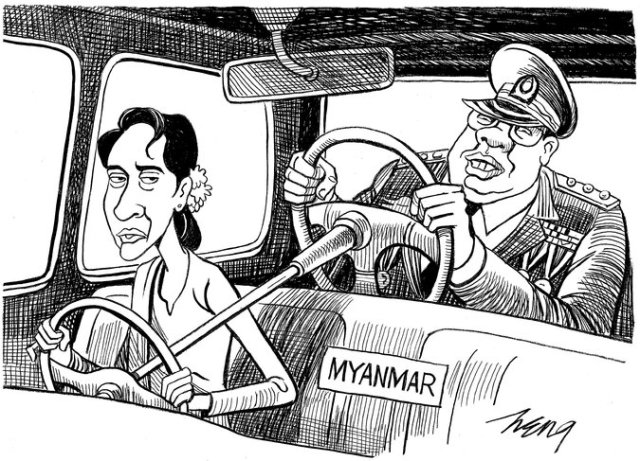
As we approached downtown Yangon, Gosu’s car was stopped by a handful of soldiers standing in the street. Without a word, one of them opened the front two car doors, examined Gosu and the front passenger’s seat with a flashlight, shut the doors and waved us on. As painless as it was, I was incredibly unnerved. Gosu apologized and said that they just started doing that, due recent changes in government. (Read more about that here)
Cartoon taken from NYTimes
Once we arrived at our hostel, I was relieved to see groups of tourists sitting on the patio drinking and chatting. A boy that looked younger than Gosu grabbed my bag and schlepped it up to our room. The official working age in Myanmar is 12 but the people look 30% younger than they really are, so at first glance it looked like the place was being run by a bunch of 8-12 year olds.
I sat on the bed and wondered what the hell I had gotten us into, thankfully Aleksiy interrupted my downward spiral and suggested that we go downstairs to get a drink.
We joined a table of Germans and Indians chatting in English, sharing a bottle of Johnny Walker. All of the Germans (except for 1, Jeremiah (?)) had to leave in the morning so they cleared out early. What ensued was a really fun night of incredible conversation spanning family, religion, politics, Myanmar, and cultural differences.
I’ll tell you about the Indians because they were my fave, although I can’t remember their names. They were 2 brothers from Punjab, one was ~55, the other ~60+. They were the bookends of 6 siblings, the only 2 still living. The younger one did most of the talking (great jokes!), and it was fascinating getting to know both them. The younger is a general practice doc, went to med school in England and lives there now with his English wife and daughter nearby (who recently birthed his first grandchild!) The older still lives in India, is a psychiatrist and a practicing Sikh, with lots of adult kids and grandchildren. He has a snow white beard that looked awesome with his dark skin, black turban, and huge smile. Towards the end of the night he was kind enough to take off his turban so I could see what was under there. To my delight he was sporting a the cutest snow-white top knot! We all laughed and I told him how stylish his hairstyle was.
We ended up polishing off the bottle of whiskey, and I fell asleep happy, grateful, and excited to be in Myanmar.







 Tales of a Southeast Asian Invasion