I hadn’t heard about the Golden Triangle prior to researching our trip, but the conspiracies surrounding the area’s illicit history are super juicy. Geographically, the Golden Triangle is the three-country border between Thailand, Myanmar, and Laos. From the 1950’s to the early 90’s this area was the primary source of the world’s supply of heroin. The opium poppy was a cash crop for the region’s ethnic minorities, and the porous frontier was a perfect environment for processing and distribution. The opium was used to help finance their civil wars- in Myanmar this meant hill tribes fighting the central government, in Laos it was Hmong rebels and Royal Lao Government vs the Communist Pathet Lao .
As if that wasn’t juicy enough, some historians allege that the CIA was actually involved in opium drug trafficking here. Opium trade was legal in Laos until 1971; the name “the Golden Triangle” actually comes from a US State Department memo on the practice. Throughout 60’s and 70’s the CIA was sponsoring The Secret War in Laos, and several historians and veterans allege that US forces either participated in or turned a blind eye to Laotian forces using the drug to fund their operations. Some pop culture references: If you’ve seen the movie American Gangster, (an Hollywood version of real-life events), this is the region Frank Lucas got his pure heroin from. Marlon Brando’s Colonel Kurtz from Apocalypse Now is said to be inspired by real-life whacko Tony Poe, who was based in northern Laos during that time.
The Golden Triangle’s golden years have come and gone, but I did allow my imagination to search for any remaining clues of the once ubiquitous drug trade. The only evidence I found that might’ve stuck was this super haggard British guy that awkwardly joined our table at a cafe in Huay Xai. He was very thin and slurring his words, moving in slow motion. He mentioned that he’d spent the last 10 years cycling all over northern Laos. It’s a beautiful country, but I really don’t understand why one would do something like that – alone, for 10 years – unless something you were relentlessly addicted to was keeping you there. He was totally out of it and didn’t remember any of us the next morning (8 hours later re-introduced himself and started the same conversations). To be fair, he never mentioned anything, but in my gut I felt like this guy was on something.
I didn’t mean for this to be a sad or scary post; it is what it is. So much of traveling is taking the good with the bad, and it’s important to learn as much as you can about areas you’re traveling to. If you shelter yourself from the bad, the sad, or the hard to stomach, you’ll never get the whole story, you’ll fail to recognize suffering, and you could miss an opportunity to help. If you are aware of the problem it makes it so much easier to find people who are doing good things and support them; become a part of the solution, inspire hope, and help along the healing process.
We left Chiang Mai just after 8:30AM on a bus bound for the Chiang Khong–Huay Xai border crossing. The crossing is about 200 miles northeast of Chiang Mai, and should take around 5 hours to reach by land. The goal was to get thru to Laos before the crossing closed at 6PM, and I wanted to allow for plenty of delays, which are apparently to be expected when traveling by bus through Northern Thailand. We bought tickets for an 8AM departure, but the clerk told us that we should probably just arrive at the station at 8 because the bus never leaves on time.
The trip started out pretty lush and green and hilly. We went through a couple of national parks and a lot of farmland. The overhead entertainment screened Oblivion but it was dubbed over in Thai, so I mostly just slept and let my imagination run wild across the surrounding countryside, which at one time in the not-so-distant past was the world’s primary source of heroin (more on this later). An ALLEGED US opium processing plant was ALLEGEDLY based at our destination (Huay Xai) during the Secret War… but have no fear, I’ve been assured that these days the only things moving through the area are tourists on their way into Laos.
Once we got to Chiang Khong we had to hire a tuk-tuk to take us to the border crossing. It was rather amusing to see an entire busload of people alight just to be immediately swarmed by tuk-tuk drivers. People rushed to grab their bags from beneath bus and raced to the nearest tuk-tuk – no one wanted to be the last in line at the border. (The same thing happens when you deplane into immigration at the airport, people attempt to casually speed walk past each other to avoid long lines at passport processing.) The proceeding 15-minute ride to the border was a passive-aggressive parade of tuk-tuks hauling tourists ready to rocket themselves out of the tuk-tuks and onto the passport processing windows at the first sign of slowing.
The building at the border crossing was comically empty – we had all rushed for nothing. There was a man lounging on a bench, smoking with his friend that jumped up and ran over to an unmarked folding table upon our arrival. We went over to him after getting our exit forms processed (seemed like the natural progression) and he tried to charge us a RIDICULOUS rate to change our Thai baht to US dollars, because “a Laotian Visa On Arrival is only available for purchase in USD.” He did a great job of making it seem like this exchange was compulsory, and the immigration officials nearby did nothing to dissuade us. We decided to roll the dice with that one and continued on past him.
At the VOA counter the clerk clarified that you could actually purchase a VOA with baht, BUT it was cheaper to pay in USD. We ended up changing money with her at a better rate and purchasing the VOAs with USD. Backwards as hell, c’est la vie. We were then told to wait for a bus that would take us across the Thai-Lao Friendship Bridge #4, and drop us just outside Huay Xai.
The bus took so long to arrive that we were eventually joined by the entirety of our comrades from the previous bus, and then some. We made friends with an Indonesian gal, Indira, and her French husband, Kenny. Once outside Huay Xai we shared a tuk-tuk with them into town, and teamed up to pick out a niceish hotel and place to eat. After a long day of traveling, it was really nice to decompress with such a friendly and funny couple. I wished we had more time with them, but alas, we had to catch the 2-day slow boat down the Mekong the next morning. ONWARD HO!
Considering the fact I’m traveling with a chef, this blog has been shamefully short on the culinary adventures we’ve enjoyed during our trip. I hope to rectify that moving forward, and there’s no better place to start than the Saichon Seafood Buffet, where we dined on our last night in Chiang Mai.
We ended up here on a recommendation from Ice, our tour guide at Elephant Nature Park. Ice is a chef in Copenhagen when he’s not at ENP (nice life, right?) so we were really excited to try his description of a local gem. He promised that it would be cheap, delicious, and plentiful. Can’t go wrong with that combo, right?
Well, plentiful it was. I was so overwhelmed I had to take a video.
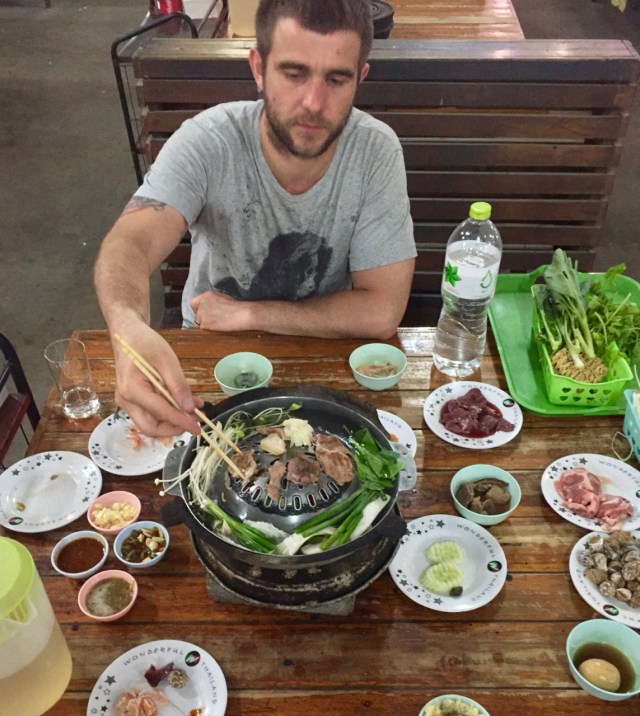
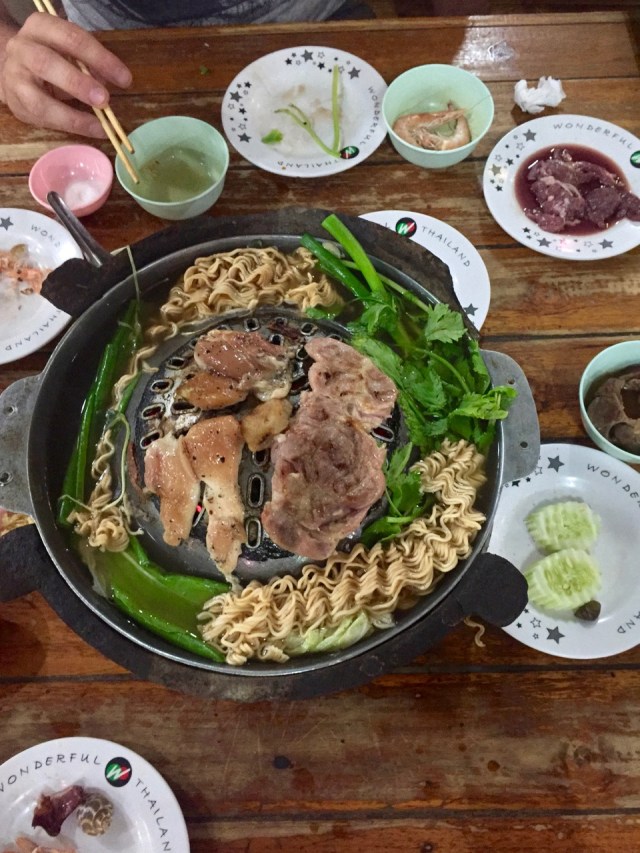
We walked into this large open-air pavilion and sat down at a wooden booth -for sure the only tourists there. The first thing I noticed was our fellow diners’ tables covered in small and medium-sized plates and bowls of marinated raw meats, sauces, seafoods, veggies, condiments, and in the center a tabletop BBQ. The BBQ burned charcoal and had a moat of broth around it. Diners would grill their selected proteins on the tabletop BBQ and add vegetables, noodles and sometimes seafoods into the broth. When the meat was finished they’d transfer it into a medium personal bowl, add as much broth as they liked, whatever garnishes and condiments they wanted, and chow down.
Unidentified Moat Broth. Included here for posterity but mostly brought to you by Aleksiy’s chopstick face
We kinda stared at everybody else for awhile before a server (more of a BBQ facilitator than a server) came over and pointed out that we could just go to the buffet at the back of the restaurant and start selecting our dishes – everything here is one price, all you can eat, just go for it.
Dessert: Eight different flavors of cubes with questionable viscosity – you grow to love it, promise
Aside from the salad bar, there were no less than 10 stations of different types of food, and a WHOLE TABLE devoted to condiments. I think we both appeared hesitant, so one of the facilitators kindly walked us thru the stations, although I didn’t understand 1/3 of what she said. None of the offerings were labeled (and remember, I’m allergic to sesame), so I was really lucky to be with Aleksiy who either recognized what things were, volunteered to try stuff, or unabashedly asked someone standing nearby. We filled up a tray each, and headed back to our table where the BBQ facilitator had the charcoal rolling.
Turns out Aleksiy’s pretty good at grilling, and I’m REALLY good at dunking veggies and noodles in broth, so we made a pretty great duo for this lil outing.
Our facilitator took a cube of something greasy (lard?) and rubbed it all over the surface of our BBQ, leaving the melty remnants at the very top/center. She then took a pitcher of broth (veggie stock?) and poured it into the moat. She grabbed some of our meats and arranged them on top of the grill, then a chopstick full of veggies and noodles for the broth. A couple of broad smiles and deep nods from us convinced her that we weren’t going to burn the place down and she left us to our devices. Aleksiy was in heaven.
The juices of whatever was grilling on top would runoff into the moat- a literal flavor saver
We went back to the buffet a couple (OK 3) more times, once we figured out what we really liked. Our BBQ facilitator would come back over and make sure our charcoal was hot enough, that we had enough broth, and occasionally clear away the embarrassing collection of plates that were piling up. It ended up being SUPER CHEAP – if I remember correctly it was only $5/person. Ice FTW.
I love elephants. Always have, since back in the late 80’s when they had a pair tucked away on the backside of the Henry Doorly Zoo. Emotionally intelligent and capable of rich social lives, elephants organize themselves into familial structures (led by a matriarch, woo!) to which they stay loyal their whole lives. They team up to protect newborns; they mourn their dead; they recognize old friends. Mothers designate a godmother to help care for her offspring and take over should she die before her baby is mature enough to take care of itself. I could nerd out on elephants all day, the more I learn – I can’t help it.
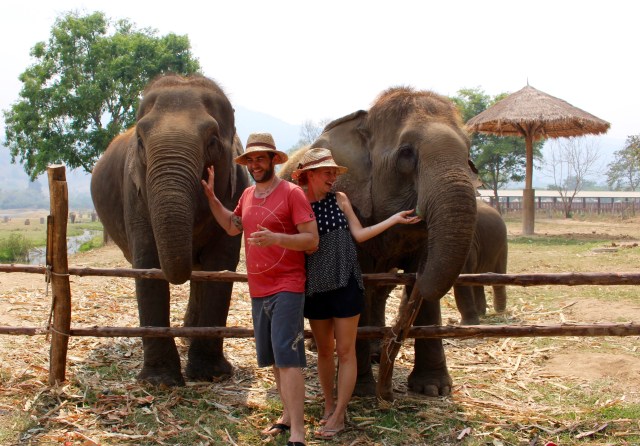
Two of my favorite things
It breaks my heart to see elephants exploited for human entertainment. Sadly, much of this mistreatment is a direct product of the fascination people have with the animals. Most of the elephants you see performing at the circus, giving rides, or marching in a parade were separated from their mother at a young age and forced to endure a tortuous domestication training specifically designed to crush their spirit (google: Phajaan). This is why places like the Elephant Nature Park are so special. The park allows animal lovers the opportunity to get up close using an ethical, kind approach, and teaches us how to contribute positively to the welfare of this endangered species.
ENP rescues abused, traumatized, sick, old, or otherwise exploited elephants by basically buying them out of their current situation. Every elephant has a story, some are absolutely heartbreaking (check out Jokia’s story – gahh), others are more, eh, bureaucratic. The park is supported by the income it makes from daily visitors, tours, and week-long volunteer opportunities, plus direct donations from Save Elephant Foundation and the Serengeti Foundation (a 501(c)(3) for US donors), and, most importantly, by getting the word out (more on this below).
Watermelon, Little Bush & Big Bush – my babies for the day
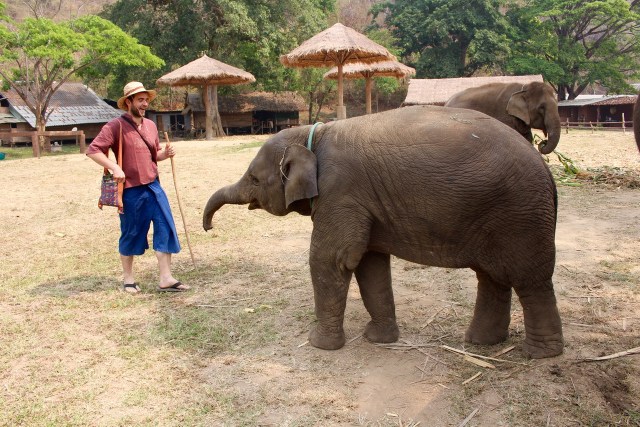
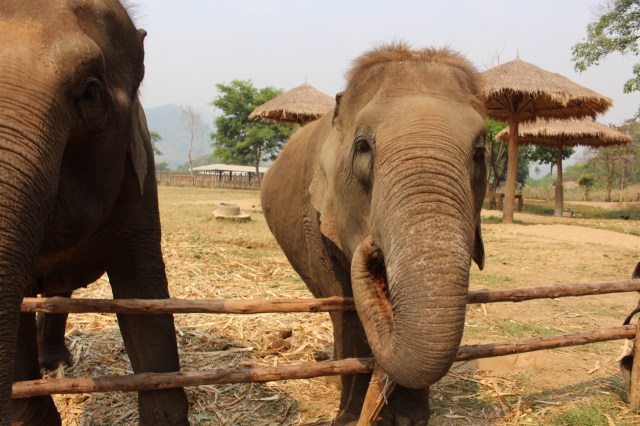
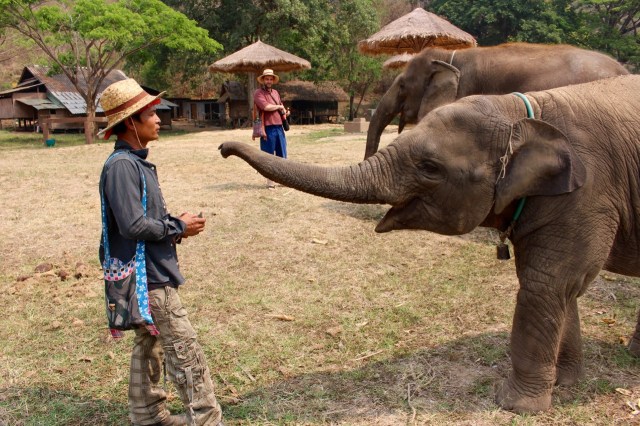
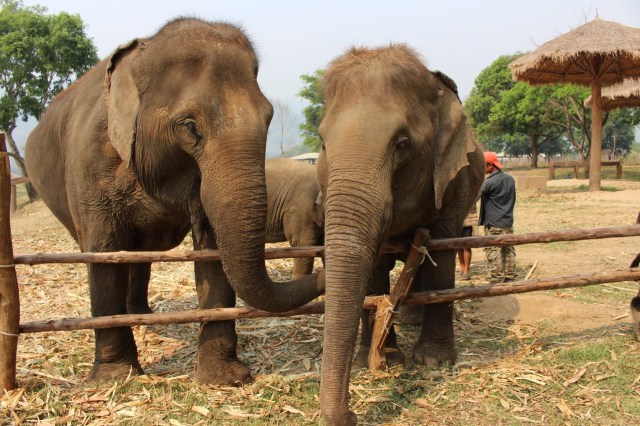
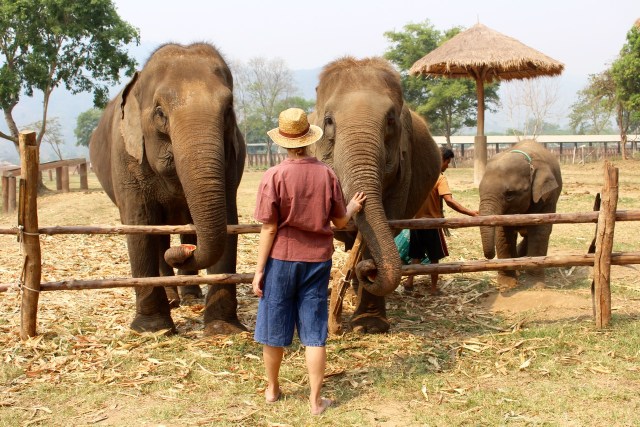
Aleksiy and I hit the jackpot the day we visited; not only did we have a great guide (Ice), but miraculously we were the only 2 people signed up for our tour. We got to spend all day with 3 elephants: Maateaw (Little Bush), an 18 month old male, Pumnoiu (Big Bush), his 30-year old mom, and Teangmo (Watermelon), his pregnant godmother.
Ice & Little Bush
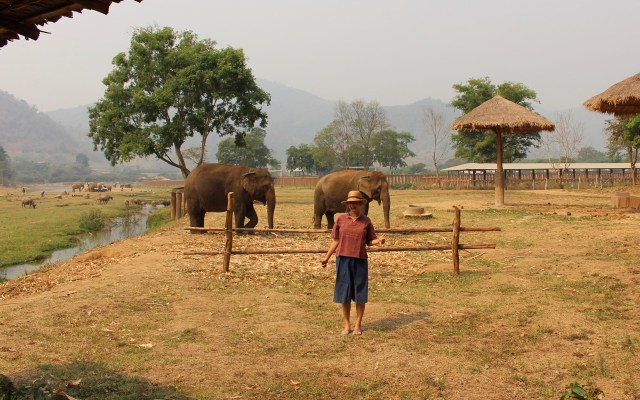
Arriving at the park had me feeling like I was in Jurassic Park. The bumpy back road opened up to a river valley dotted by small herds of elephants, free ranging all over the valley. I was awestruck and could not wait to get closer. When we got out of the van and I realized we’d be spending the day with a baby elephant, I nearly had to put my head between my knees. We changed into loaner clothes and set off to meet our crew.
Just a tad excited
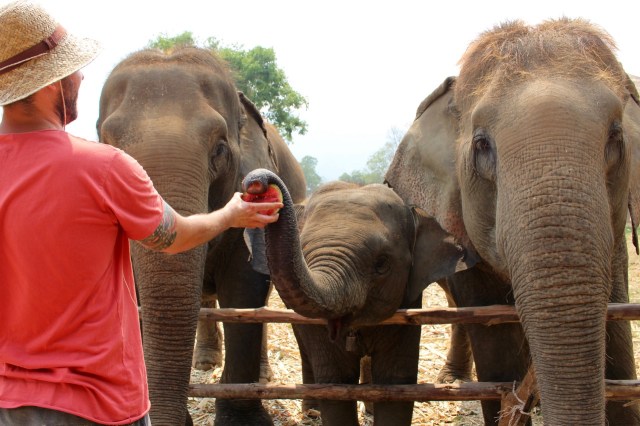
Our introduction to Big Bush, Little Bush, & Watermelon began by feeding them large laundry baskets full of fruit (positive conditioning). Ice warned us that Little Bush could be naughty, and to be a bit careful around him. This worried me, but I quickly saw what he meant – rather than waiting for Aleksiy and I to offer him fruit, he started diving face first into the basket, totally unaware of his size/strength and our personal space/balance. We quickly gave up and offered him the whole thing, it was funny to watch him dump it out and sloppily go for it, almost like a human toddler would’ve. The older girls were much more patient and gentle, the dexterity with which they accepted the fruit and curled it into their mouths was impressive. When the baskets were empty they gently searched our hands and pockets, confirming with their trunks that all the fruit was gone.
No manners, this guy
After their snack we took them on a hike up the side of the valley. The herd rolled around in some mud to cool themselves off in preparation for the walk. Our hike lasted about 2 hours with a stop for lunch, and the elephants kept their mahouts busy by wandering off and making their own path. I quickly understood why Little Bush had a cowbell on. The gentle giants were so sweet and Little Bush continued to demonstrate his playful spirit and carefree lack of boundaries.
When we returned to the valley it was time to give the herd a rinse –giving us all a much-needed break from the heat. They loved the water – Watermelon laid down and rolled over, allowing us to wash chunks of mud off her back. Little Bush would disappear completely, using his trunk as a snorkel, swing it around like a helicopter, and slap the water it with it, splashing us. They reminded me of big happy dogs, so playful and good-natured.
After the rinse we changed back into our normal clothes and got to feed them one more time. Little Bush allowed himself to be handfed this time, but insisted that we peel his bananas or he’d throw them on the ground. If we weren’t moving fast enough he’d go straight to the source. Goofball!
The more time we spent with our elephants, the more their personalities shone through. I fell in love with their big eyes and long eyelashes, the happy wagging of their ears and the friendly touch of their trunks.
After the feeding we said our goodbyes and Ice gave us a tour of the rest of the facility. We met several other groups of elephants, scars of their past abuse clearly visible. We met an elephant that was blinded on purpose by an angry mahout. We met one elephant that was crippled by an illegal logging accident, another that had part of it’s leg blown off by a landmine. Several had scars and holes in their ears from the hooks their previous mahouts used. It was sad, but I just kept reminding myself that these elephants got their happy ending.
This elephant was injured by a landmine while working in the illegal logging tradeThis is Lucky, she was blinded by a spotlight during her years as a circus elephant. Still sweet though.
There are only about 30,000 Asian elephants left on the planet, and of those, approximately 20% are in captivity. Without our help, they will be extinct within our lifetime. Here are some ways you can help the Elephant Nature Park on their mission, taken from their website:
Visit the park, or tell your family and friends that they are welcome to visit our website and park., or sign up as a volunteer.
Follow us,Tweet and share our activities on our social network community.
Serengeti Foundation has helped Elephant Nature Park since our inception. US residents may click to donate here and claim 501(c) tax relief.
Let people at home know that there are only 30,000 Asian Elephants left on the planet. (Imagine this in human terms, as under a third of a sports stadium crowd)
Do not support elephant poachers by buying ivory or skin products whether allegedly legally obtained or not . Demand causes death to these innocent creatures.
Write a story for your local newspapers describing the plight of the elephant and how we can all assist in their survival
We arrived in Chiang Mai around 7PM after a delightful Bangkok Airways experience (they had a lounge at the Mandalay airport with FREE SUSHI – I can’t tell you how life changing that is after 2 weeks of Burmese food). Took a cab directly to Rosa Place, our guesthouse a couple blocks outside the ancient city walls of Chiang Mai’s old town area. Rosa Place was recommended by our friends Matt and Brooke, and I could not wait to meet Rosa, who had been described as nothing short of really, really fun.
Well, the rumors were true. The first night we arrived Rosa threw a party for some of her friends who had just won a motocross championship. One minute it was just Aleksiy, Rosa & I, the next, we were joined by a dozen excited local kids and about 20 platters of food Rosa whipped up out of nowhere. After decimating the food, we moved on to meet some of Rosa’s other friends at an expat bar down the street. I was absolutely delighted to discover that Rosa’s crew at this bar was a pack of gorgeous, outgoing and witty lady boys. They were in 4 inch heels and miniskirts, kicking everyone’s asses at pool and talking smack. I sincerely regret having no photographic evidence of this evening, but I do remember we finally got sent home when our friend/fellow Rosa Place inhabitant Dylan attracted a cop’s attention for playing his guitar outside the bar.
The next morning we woke up and went on a self-guided (aka aimless wandering) tour of the Old Town, which is filled with restaurants, shops, bars, hotels, and other tourist attractions and activities.
Inadvertent ‘surprise face’ upon trying the SOUREST home-brewed kombucha I have ever tasted. We drank the whole thing, because I love sour and I love kombucha, but this stuff seriously gave me heartburn.
When we got back, Dylan was gearing up to meet some friends at Huay Tung Tao, a lake about 20 minutes north of the city. With some encouragement from Rosa, Aleksiy and I decided to join. We borrowed a moto & some helmets from a friend of Rosa’s, and after Aleksiy took a few practice laps, we were off.
I was initially very hesitant to rent a moto for street driving – I had read some horror stories – but once you start traveling you realize that those stories are exceptions to the norm. Renting a bike is inexpensive, they’re relatively easy to drive, and once you have your own means of transportation your possibilities for exploration are endless. All it takes is a little homework to find a reputable rental company (or just get one from your hotel/homestay). I am grateful to Rosa & Dylan for calming my fears because the rest of our trip has benefitted immensely (not to mention we’ve saved a TON of time, money and irritation by avoiding all-day, all-inclusive tours).
The lake (once we found it) was awesome. Little bamboo huts hovered just over the waterfront – you could help yourself to one and lounge there all day, ordering food & drink from nearby BBQ stands. There were people hanging out everywhere, playing guitar, flirting, eating BBQ, playing with friendly stray dogs and drinking cold beers. The lake looked kinda dirty so we didn’t swim, but we stayed until the sun started to set and headed back to the city before it got too dark.
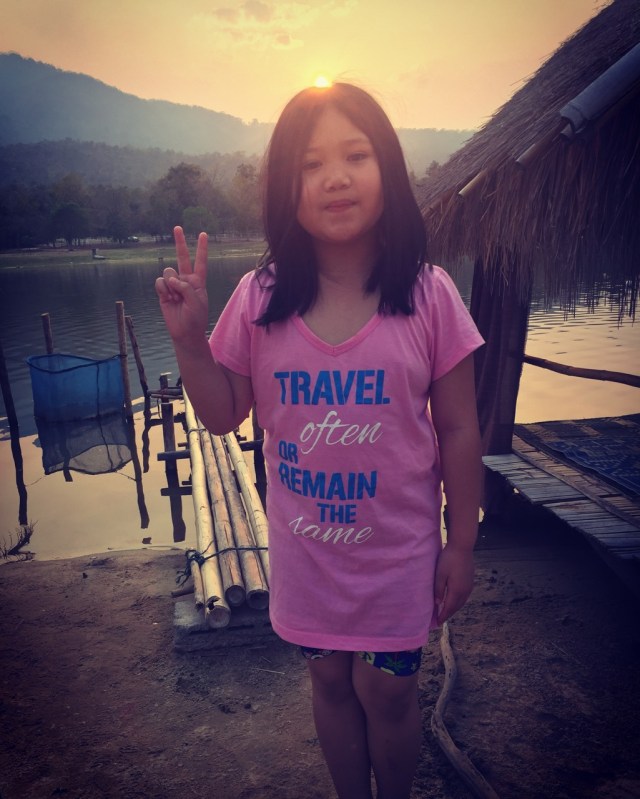
Met this cutie at Huay Tung Tao
The next day we went about 45 minutes outside of Chiang Mai to hike Mae Sa Waterfall, which is actually 10 layers of waterfall with pools that you can chill in at the base of each one. It was great fun for a hot day, albeit a little bit crowded – being a popular picnic spot for large families.
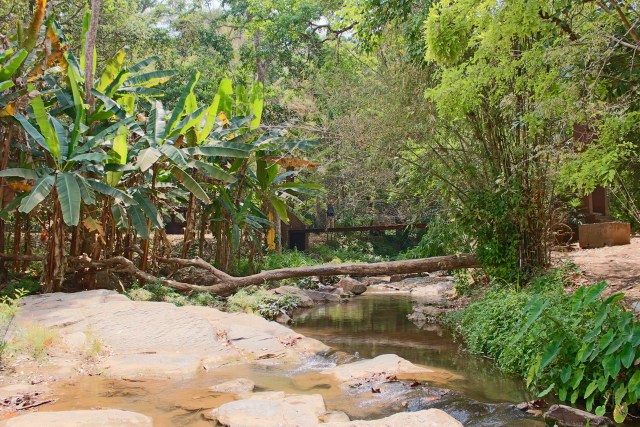
Where’s Waldo? Traversing a bridge at base of the first level of the falls. This is the only photo we have of Mae Sa because we decided to leave the camera safely locked away.
We returned to the city and went to bed early in order to be up bright and early for an excursion I had been eagerly looking forward to for months: ELEPHANT DAY!! (which deserves it’s own post, so stay tuned…)
We spent 12-13 days in Myanmar. Just like most countries in the region, Myanmar and its people haven’t had the best of times in the past. Colonization, civil wars, natural disasters and military oppression have all taken place in the past 150 years, making Myanmar one of the poorest countries in Asia and in the world. Military government had been in charge since the early 1960’s, ruling with an iron fist and performing genocide on multiple occasions.
We arrived when a huge political reform was taking place. There had been democratic elections and the National League for Democracy/the good guys had won with over 80% of the votes. They were to elect a president and a prime minister, change the old military laws and lead the country to better times! Easier said than done because the generals from the previous government, who are still powerful military leaders, wouldn’t let them change much.
Myanmar is an interesting place. It is very safe. It is packed with religious monuments. It is very hot and dusty. Standard of living is low. People are polite and genuine.
We got the feeling we were in a special place. A bit rough but very unique.We also got the feeling it wouldn’t stay the way we experienced it for long. All I mentioned above will probably make Myanmar a top tourist destination in the very near future. Millions of people will be going there, spending tons of money. Everything will change.
We arrived in Mandalay around 4:30AM fresh off a night bus from Inle Lake. We missed an opportunity to get off the bus near our hotel and ended up having to take a taxi back towards the center of the city. Our driver had a great command of English, so we arranged for him to pick us up in the morning and give us a day-long tour of the city before taking us to the airport that evening. After a nap and a shower at the cheapest hotel we could find, we were ready to go. We were surprised to see a completely different taxi driver waiting for us – he explained that our original hire couldn’t come because he had a date with his girlfriend (who knows; if it’s true, props to her for slaying).
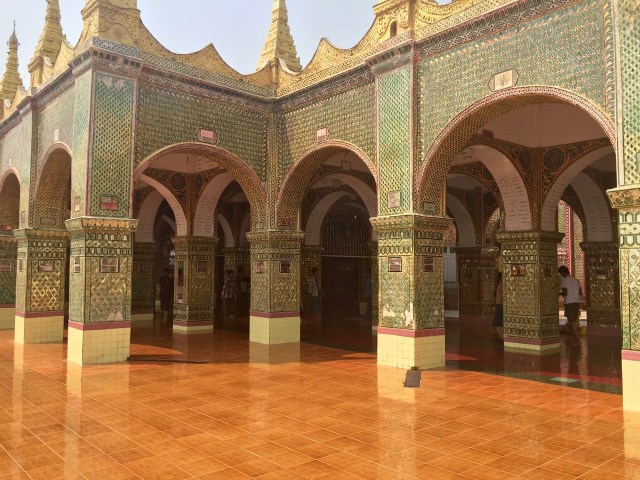
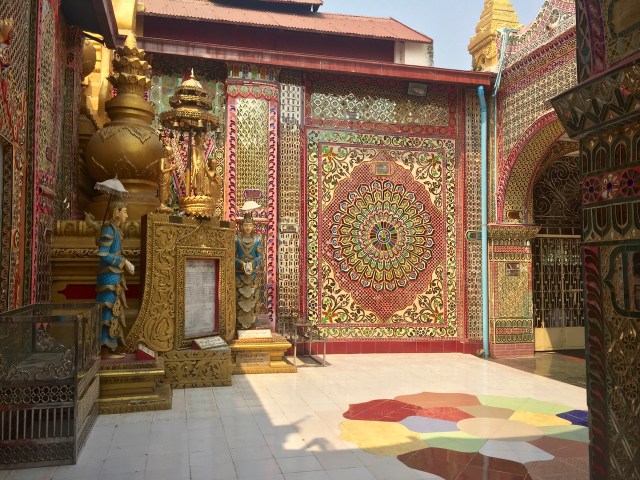
First stop was Mandalay Hill, the single giant bump on the flat plain that is Mandalay. At the top of the hill is Su Taung Pyi Pagoda, offering impressive views of the city below. I was unprepared for a Pagoda visit and unfortunately had to borrow a longyi, but was happy that I didn’t have to miss out on the views. (Sorry for no photos of the view, it was a dusty day and none of my photos looked that great)
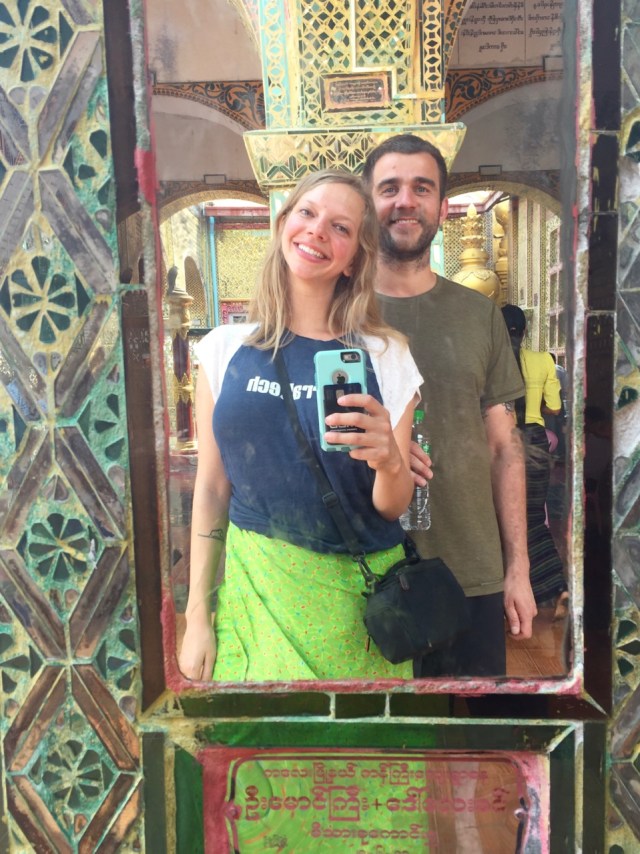
Amazing longyi + amazing husband = happy girlPhoto doesn’t do it justice- the mosaic walls consisted of tiny little mirrors and this place was sparkling!Another gorgeous passageway
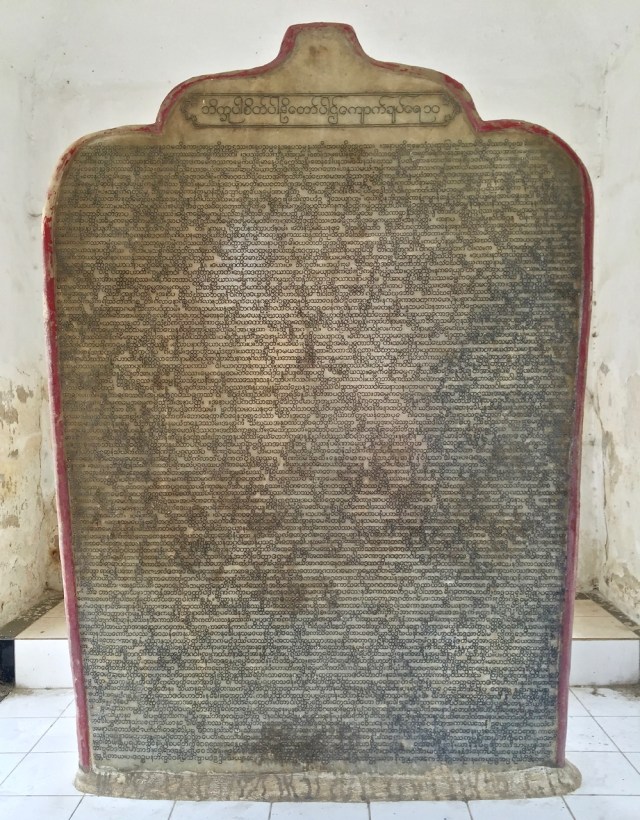
Next stop was Kuthodaw Pagoda, home of the Kuthodaw Inscription Scribes, a UNESCO World Heritage Site. The central stupa is surrounded by 729 mini temples, each containing a huge slab of marble inscribed with Buddhist scripture (the entire Tipitaka Pali Canon) in round squiggly Burmese script. The King of Burma had these commissioned in 1860 because he was worried that that the teachings of Buddha would be lost due invasion of the British. The slabs have been given the nickname the “world’s largest book” – however the Guinness Book of World Records would disagree.
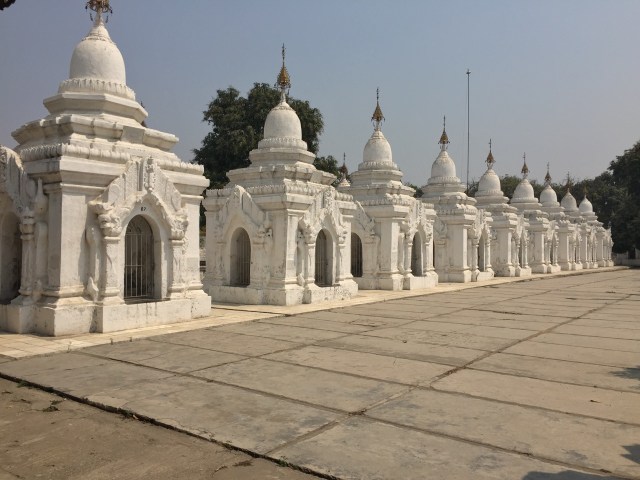
Mini Temples housing the slabsA monk would carefully copy the text onto the marble, and then a stonemason would would chisel it out and fill it with gold leaf. It took a monk 3 days to finish a tablet (front and back) and a skilled stonemason could complete only 16 lines a day. When the British invaded, they did steal all the gold leaf out of the slabs, but the slabs remain.
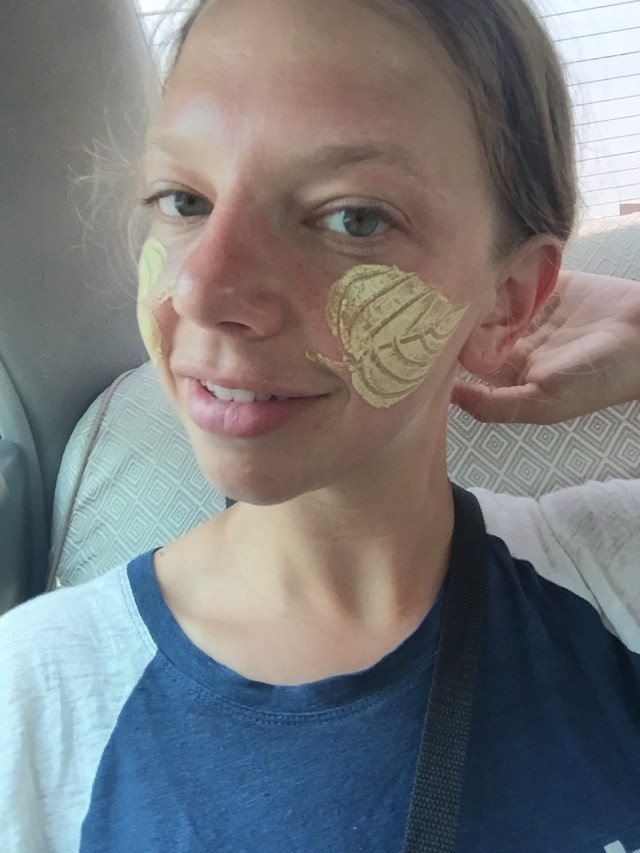
As we headed next door to the Sandamuni Pagoda, a sweet girl near the entrance offered to decorate my cheeks with some thanaka. Knowing that this was a gesture of kindness, I obliged and ended up with a sweet makeover for the day. The thanaka smelled great and felt cool in the heat, and I can totally understand why it was so popular and common among the locals.
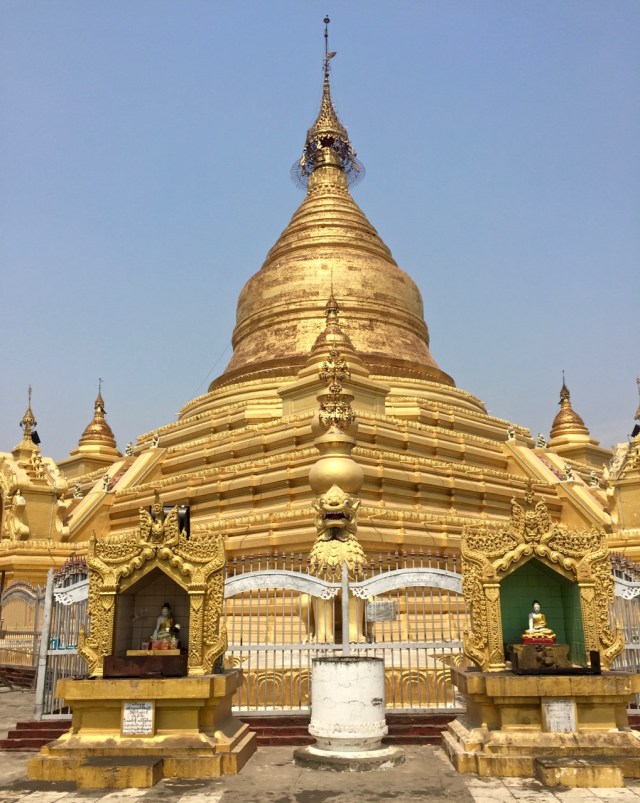
The Sandamuni Pagoda features a huge golden stupa in the center, surrounded by thousands of smaller white stupas housing 1774 marble slabs inscribed with commentary on the Buddist scripture featured at Kuthodaw. They call this “Volume II of the World’s Largest Book,” and I found this space to be more peaceful and awe-inspiring than it’s more famous neighbor.
I really liked that tiger/dragon/dog thing that guarded the stupa
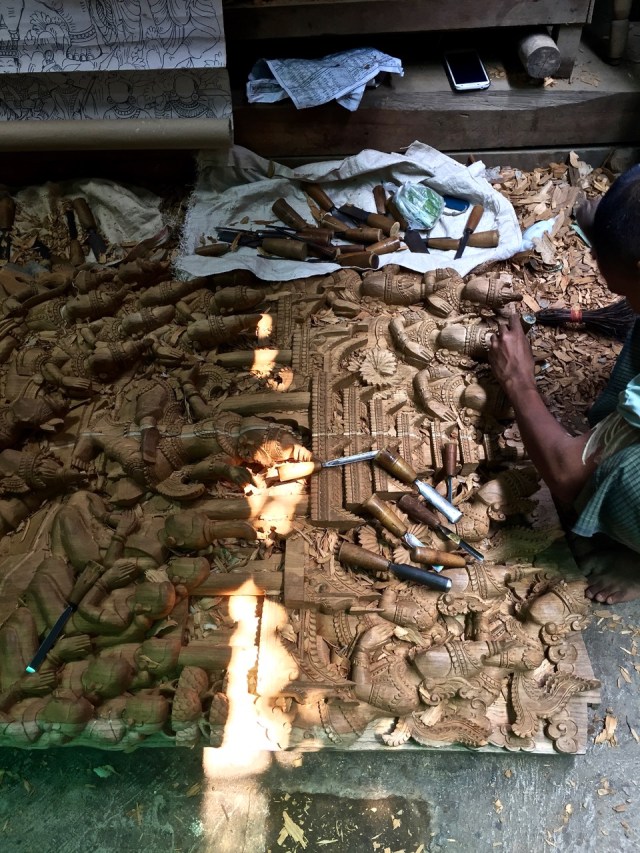
At this point in our journey Aleksiy and I were feeling stupa-d out, so we opted to visit some local workshops instead of more temples. We went to a textile workshop, a wood carving/tapestry workshop, and (my favorite) a gold leaf production site.
I like this photo because you can see the progress – the people in the bottom left corner have very little detail, while the people in the upper right are all blinged out – all using the simple tools he’s laid out
This was truly impressive – so gorgeous and all beaded by hand
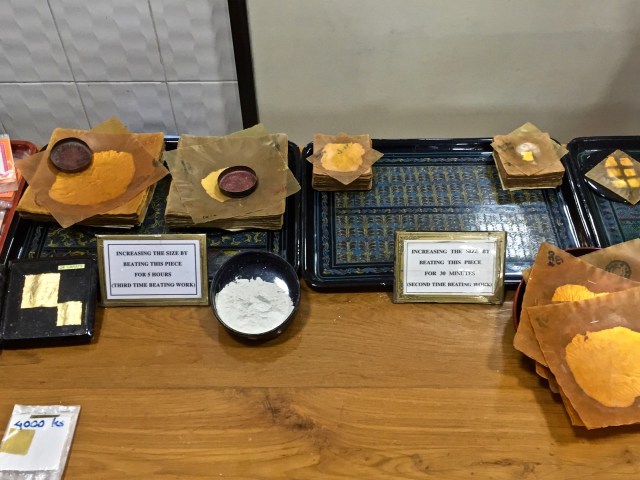
In a lot of the temples/pagodas/stupas we visited, there were women selling little pieces of gold paper that we discovered to be gold leaf. People buy them and attach the gold foil to statues of Buddha as an offering. Here, we got to see how those little sheets of gold leaf were created.
They read right to left, so we must as well. They put a piece of gold foil the size of a fingernail unto the block at the far right, and pound it with a sledgehammer until it is the size of a silver dollar. Then, they cut that into 6 pieces…and beat each individual piece for another 30 minutes to make it a little larger than a silver dollar. Next, they beat it for 5 HOURS to press it to about the size of a small grapefruit. All in all, the gold gets hammered 3 different times, for 6 hours to make it thin enough to sell for a reasonable price – the little square in the bottom left of this photo is about $3.50USD
The last stop on our whirlwind tour of Mandalay was a visit to the “Bridge of Mandalay,” formally known as the U Bein Bridge. The bridge is about ¾ of a mile long, built around 1850, and is said to be the oldest and longest teakwood bridge in the world. That said, why we decided to walk back and forth across it remains a mystery, but I am glad we did it, because it was extremely entertaining.
First of all, Aleksiy and I are quite a bit larger than your typical Burmese person. Average height for a full grown male is 5’6” – I’m guessing average weight would be around 120. Lets just say the builders of the bridge were not considering Aleksiy and I.
The boards would rattle and shift as we picked our way across
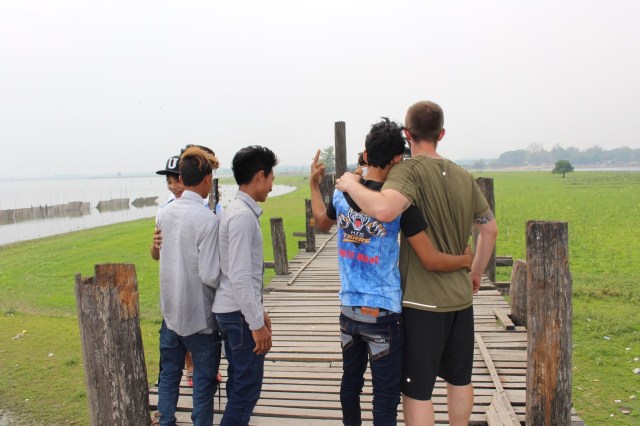
Second of all, walking the bridge (especially on a Sunday) is a decidedly popular local activity, and I really think we were the only foreigners out that day. We were asked to take photos with people not once, not twice, but FOUR TIMES. Especially Aleksiy, with his tattoos (or maybe just his handsome good looks)– people were fascinated. I was so entertained.
This was the first group to ask- first we thought they were asking our help taking a group shot, then we realized they wanted photos with Aleksiy… We thought perhaps he looked like a famous person we weren’t aware of, until it happened again…Fan club
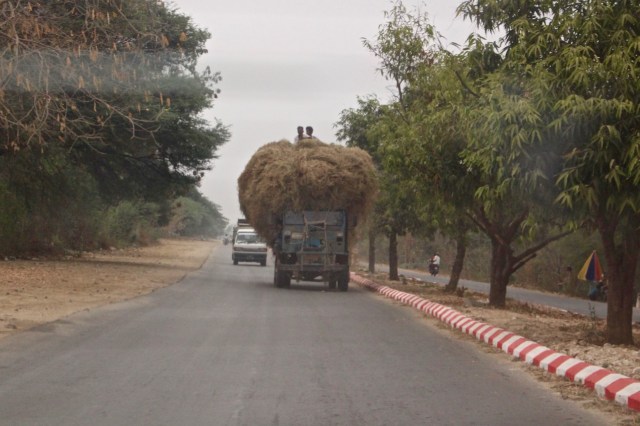
We made it back to the cab, not knowing whether to feel like celebrities or freak shows, and headed toward the airport. I have to say, this was probably the best way to do Mandalay, as everything is pretty spread out, it was 102 degrees, and the whole day tour only cost about $30. I was a little sad to be leaving the wild frontier that was Myanmar, but very much looking forward to a more modernized Chiang Mai – and a return to delicious thai food!
Traffic on the way to the airportNappin on the commute
Towards the end of our trek, I asked Ma le how much further (her answer was “1 hour”, every time) and she pointed to a shiny little triangle between two mountains and told me it was the lake. I figured something had gotten lost in translation, because what she was pointing at certainly wasn’t water. It was shiny and it glimmered like the tin roofs of the villager’s houses – I thought maybe she was pointing out our final destination, a village near the lake.
Long shallow boats docked beneath the stilt houses
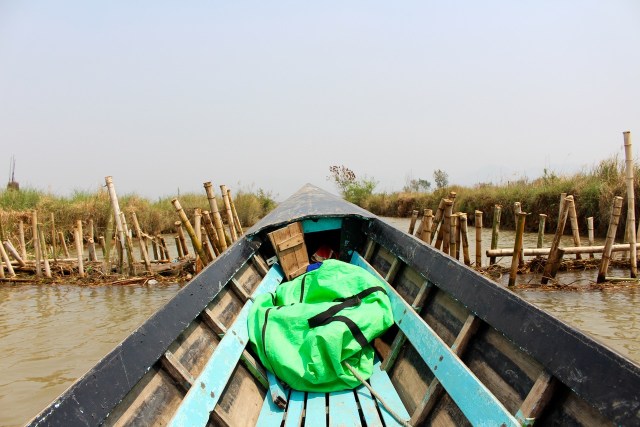
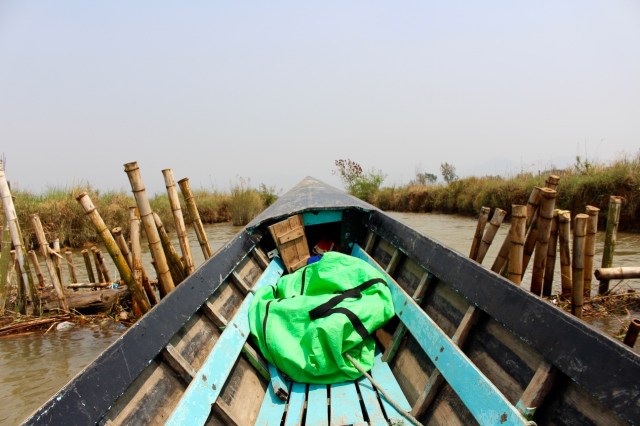
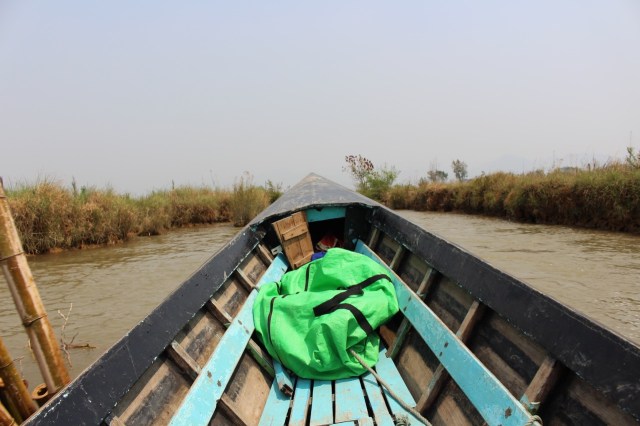
As we got closer, I realized that Ma le WAS pointing at Inle Lake, and that the shiny glimmering rooftops were the roofs of houses built on the water, on stilts over the lake. After a final meal with our trek group, Ma le loaded us into a canoe-like motor boat and we zoomed north, to the village of Nyaung Shwe, where we would stay during our time at Inle.
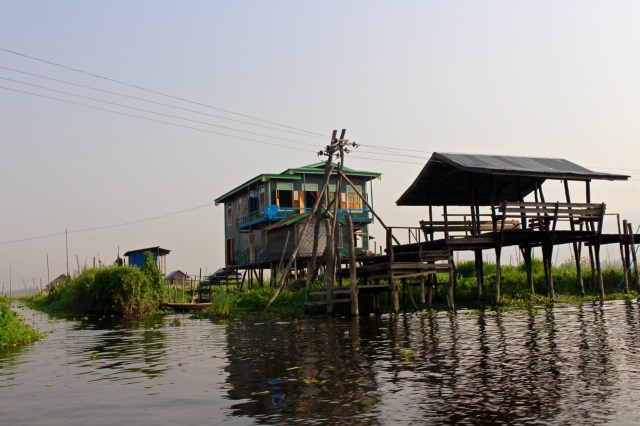
Inle Lake is a unique place. The lake itself is not very deep (average depth is only like 7 feet) and it’s clarity and fertile surroundings have encouraged villages to form and subsist upon the lake. Most of the villagers that inhabit the lake live in the stilt houses and have developed plots of floating gardens near their abodes. Fishing is also a source of income for the locals, as well as handicrafts like traditional textile weaving, ornamental carvings, and now, tourism. Most tourists stay in Nyaung Shwe, a city just north of the lake, easily accessible by boat. Accommodation on the lake itself is limited, expensive and isolating.
Typical standalone stilt house, with boats docked underneathA beautiful day in the neighborhoodThis was a cheroot storeBar & restaurant – just like the Ozarks!
The satellite on this house made me smile
I got to learn a lot more about life on the lake during a boat tour I took with Canelle and Wes, a friendly Canadian fellow we met in town. Luckily, Canelle had done her homework and knew what ask for when we were negotiating the itinerary with our boat guide. Apparently, there are several “fake” markets and unethical activities on the lake that exist for the sole purpose of tourists’ entertainment. For example, you can visit a “long-necked woman village” which is essentially a prop town where rural women of the Kayan tribe are on display for your viewing pleasure and a small entrance fee. The saddest part about it, is that the women don’t even live nearby so they are essentially taken from their village and stuck in a human zoo until they’ve made enough money to go back home. Skip that.
Our boat captain and his reluctant assistant
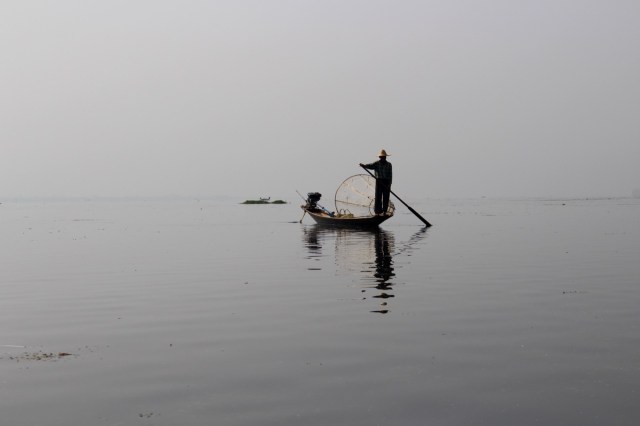
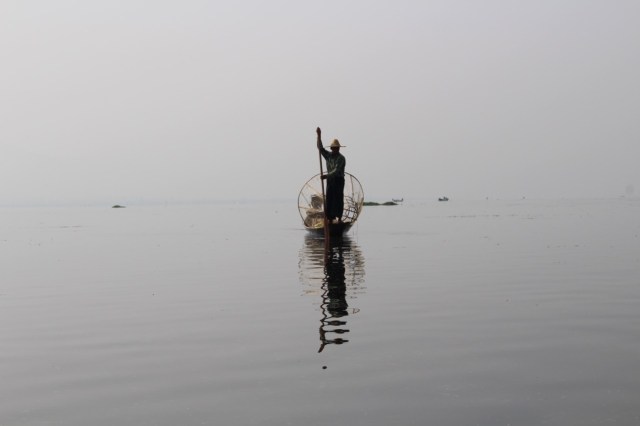
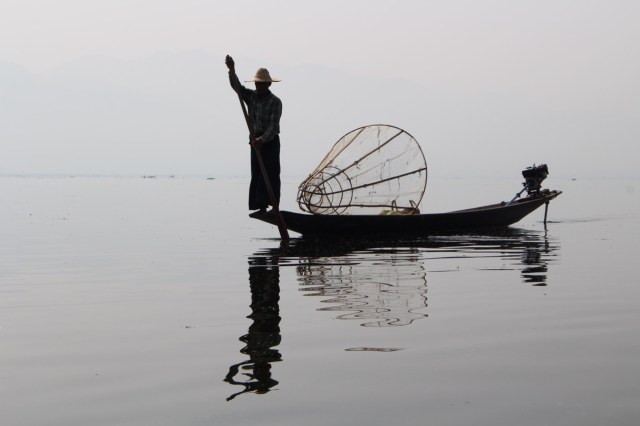
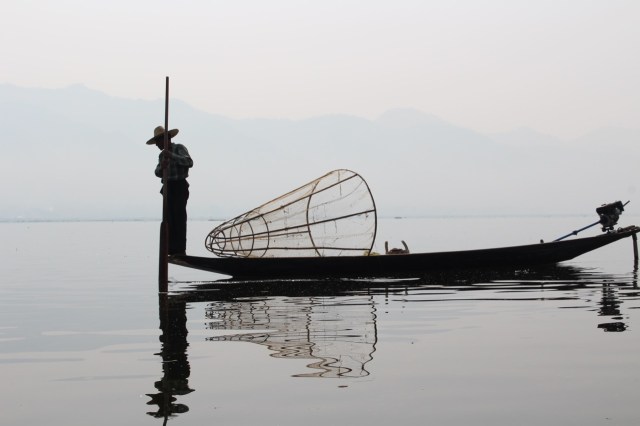
We set out early to watch the gorgeous process that is Inle’s traditional fishing methods, zooming past “fake fisherman” that dress the part and take tips for photos. The real deal is a mesmerizing sight– fisherman stand on the very tip of their canoe-like boats and paddle with one leg wrapped around an oar, while they slowly lower a basket into the water and trap the fish.
I have approx 100 photos of these guys
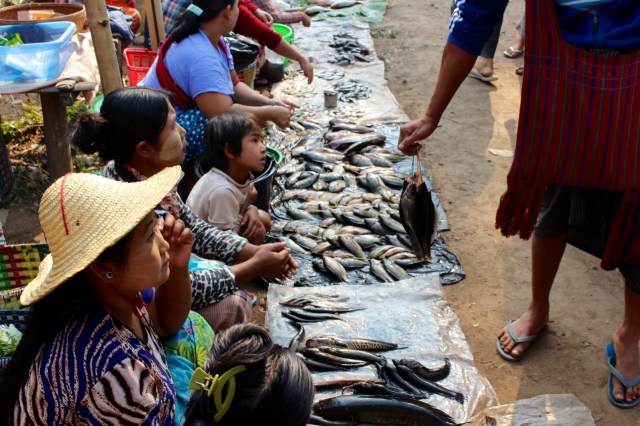
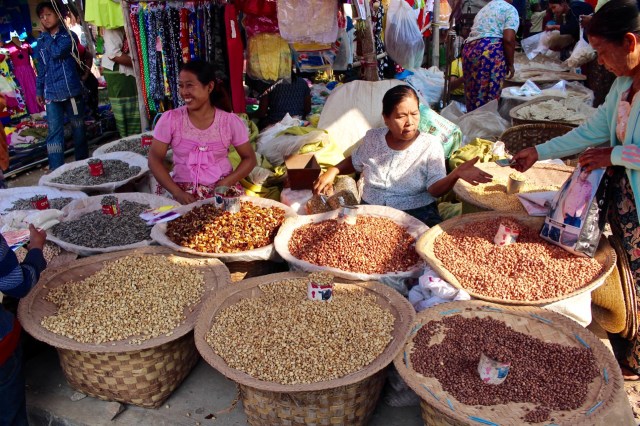
After excessive documentation of the fishing process, we moved on to the local market, which mostly featured food. You can tell pretty quickly if a market is genuine or not by the wares offered for sale. Some markets are full of tourist crap, which you begin to recognize very quickly because it’s for sale on every corner. Others, like this one, cater to the locals and are so much more interesting.
Some of these fish were still moving
Sometimes you feel like a nut, sometimes you don’t
After the market, our next stop was Tharkong Pagoda. The ride to the pagoda was harrowing- weaving through curvy canals in our 30ft boat, playing chicken with other boats while trying to thread the needle through the rudimentary canal locks. The first couple of times I was ass-clench terrified, after a couple successful passes I began to enjoy the rush – funny how that works.
Oh god… Oh no… too close too closeoh we’re gonna die, too fast, too tighttoo fast too fastgonna die gonna die*holding breath*Yay, you’re alive!
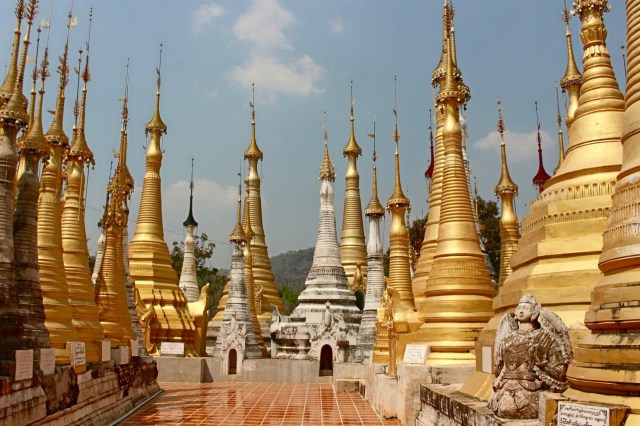
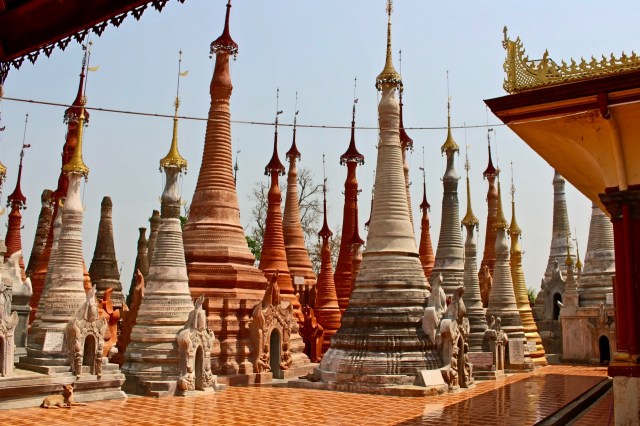
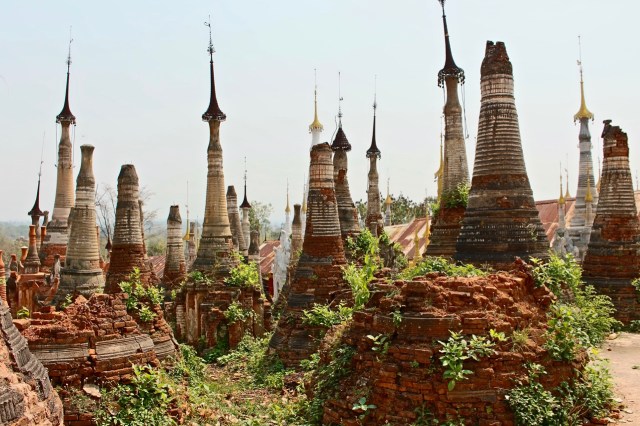
The entrance to the pagoda was a long hallway lined with hand-made items for sale: sand paintings, textiles, purses, wooden masks, puppets, etc. The walkway was so long we thought perhaps we weren’t headed in the right direction. The pagoda itself was immemorable, but the stupas surrounding the site were fun to explore. All in various states of restoration, it was like a mini Bagan. One can sponsor the restoration of a stupa; it was fun to search around for the English ones (there were only 2 or 3, most looked Burmese or Thai, but we did see some Chinese and Russian)
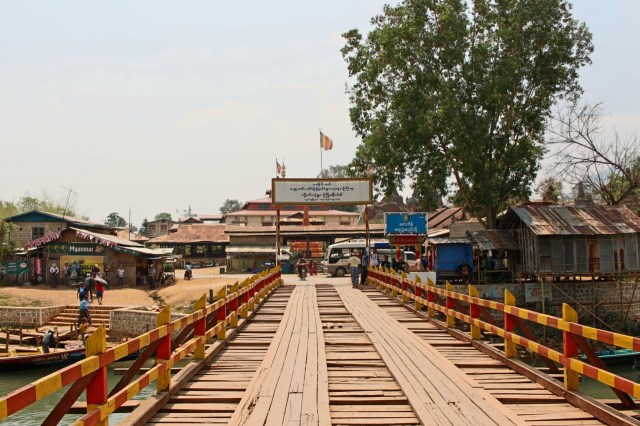
The boat jetty & charming town surrounding Tharkong PagodaApproaching the pagoda over the canalCanelle in the long hall of vendors
Snoozing PupsGreat place for hide & seekThe bells at the top of the stupas jingled softly in the breeze
Nature finds a way
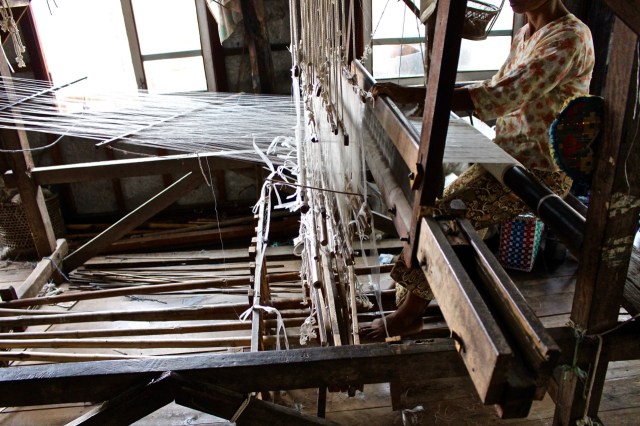
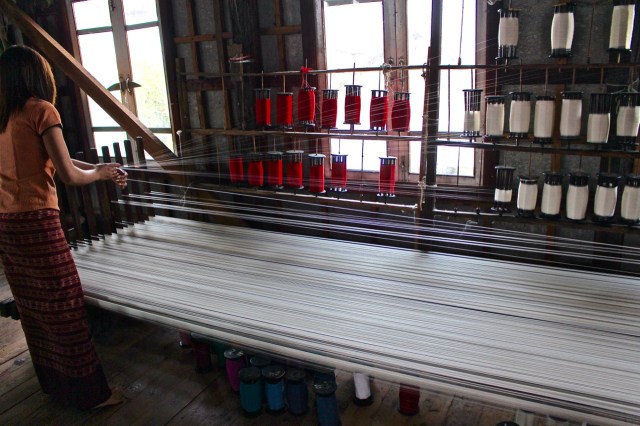
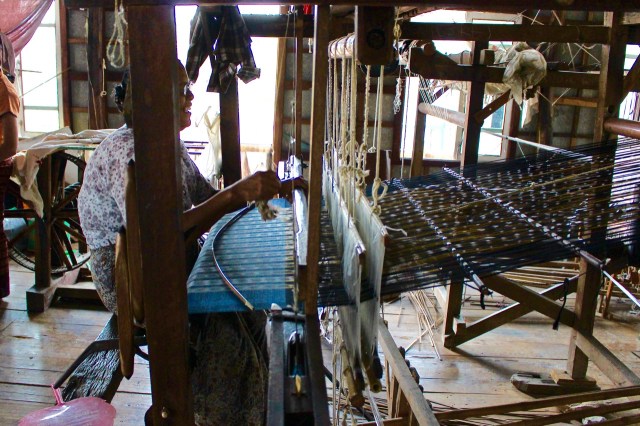
Our next stop was a textile factory. It was fascinating to see where lotus silk comes from – break a lotus twig in half and the gooey fibers are strong enough to be woven together to create thread. End product is incredibly soft (but v. expensive). We watched the women weave intricate patterns by hand, in awe of how quickly they were moving regardless of the tediousness of the process. They looked like they were playing an organ of wood and thread, with lots of pedals at their feet and strings of thread at their fingertips. As they pedaled, the big wooden bobbin clacked back and forth across the length of the loom, giving the warm room full of moving parts a rather hypnotizing quality.
So many moving parts
Preparing the thread for the loomAfter years of experience, these women were so quick & talented
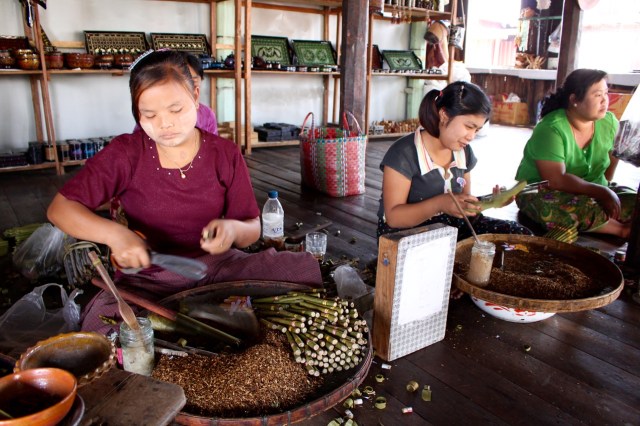
After a lackluster lunch on the lake, we moved onto a little shop where women were hand-rolling mini cigars- called cheroots. There are many different variations of a cheroot, but here you had a choice between sweet and full flavor. The sweet tobacco was delicious – flavored with honey, tamarind, brown sugar, banana, alcohol, salt, star anise & fennel seeds, it tasted similar to a clove cigarette.
Their boss promised me that school was on a holiday
Our last stop on the way back to Nyaung Shwe was a drive-by of the floating gardens – a large community vegetable garden on the lake. We had previously seen farmers filling their boats to the brink with lake-bottom weeds, I figured it’s nutrient rich properties make great fertilizer. Here, our boat guide explained that the weeds are used to form the floating garden beds, anchored in place by bamboo poles. The gardens are able to rise and fall with the water level, totally resistant to flood and drought. Depending on the season, they can grow tomatoes, cucumbers, squash and eggplant, plus an assortment of beans and lentils.
Rice paddies on a shallower part of the lakeThey had to start bailing out that boat– it was sinking with the weight of the lake weedTo the brimFarmer tending to her rows of veggie bedsFarmers laying down more tomato beds
We probably (Aleksiy would say definitely) allocated too much time for our visit to Inle, as there’s not much to do there aside from exploring the lake, which you can really do in 1 day. That said, Canelle, Aleksiy and I did ride bicycles to a nearby vineyard for a sunset wine tasting on the patio. Although the wine was a joke, the views and company were great – all in all a lovely time in Inle Lake.
From Bagan we flew to Heho, the airport closest to our next stop: Inle Lake. There are a couple of ways you can get to Inle from Heho; you can take an hour-long taxi directly there, OR you can take an hour-long taxi the opposite direction to a town called Kalaw, and spend 2 to 3 days trekking in from there. (Trekking = hiking; no one says hiking) We had heard from several other travelers that this was an amazing experience not to be missed, so we rearranged our plans a bit and made it work.
Kalaw is a very small town not known for much other than it’s trekking businesses. There are some pretty views, a weekly farmers market and a good restaurant, but that’s about it. We killed some time at the market, shopped around at different trekking companies, and got to know Marc, the Belgian proprietor of our B&B. Marc is super intelligent (engineered an eco-friendly water filtration and plumbing system for the B&B) and has had a ton of interesting life experiences (spent a large portion of his life working at non-profit NGOs all over the world), but I loved him most because he made his own yogurt, banana bread, and jams from local fruits. Obviously culinary skills are the way to my heart.
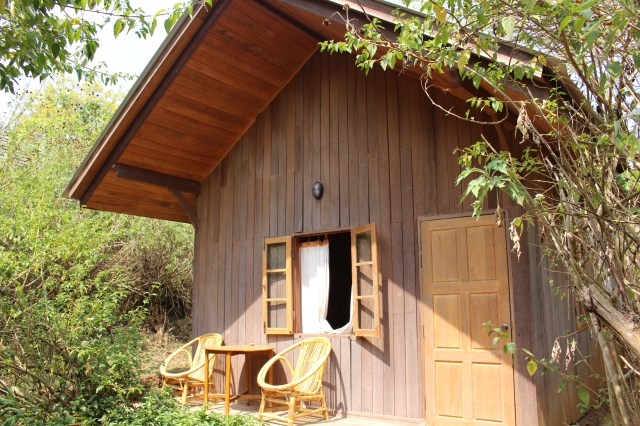
Our little bungalow at Marc’s Thitaw Lay House in Kalaw
Anyhow – there are a number of different trekking routes between Kalaw and Inle Lake, but the one we chose was 2 days, 1 night and 32 miles in length — 17 miles the first day, 15 miles the second, with an overnight homestay in a tribal village. The first day began around 8AM, with a mid-morning stop to meet a woman from a local tribe and watch her weave a handbag. We lunched at another village around 1PM, stopping for an hour (30 minutes we ate, 30 minutes we napped). The rest of the afternoon we trekked, arriving at our homestay village around 5PM.
Tribal woman weaving purses by hand – each purse takes 8 hoursLittle sweetie welcoming us in for lunch – her house was made entirely of bambooBamboo ladder inside the home
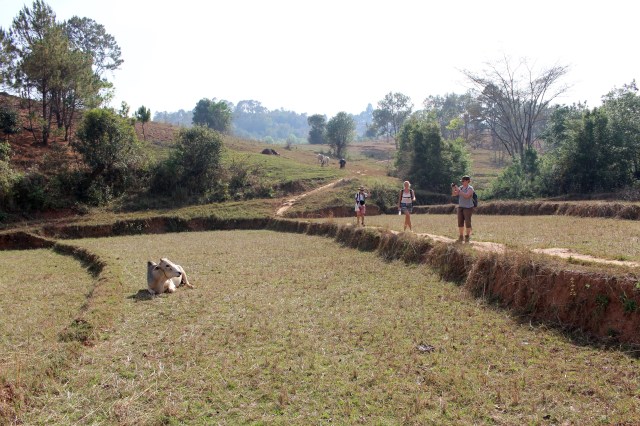
The terrain was primarily farm land, but much different than what Nebraska & Iowa offer. We walked along a tall ridge, each slope as far as the eye can see parceled out into different types of vegetation, and farmers out in the fields doing everything manually. We saw a lot of ginger, sweet potato, turmeric, and of course RICE on RICE on RICE on RICE. We saw men mining limestone to use for their betel chews. Along the way, our guide Ma le (sounded like “Molly”) would offer facts on what was growing, how things were planted, and other interesting tidbits on Burmese agricultural methods. Aleksiy stuck close to Ma le and asked a ton of questions, which the whole group was grateful for.
This slideshow requires JavaScript.
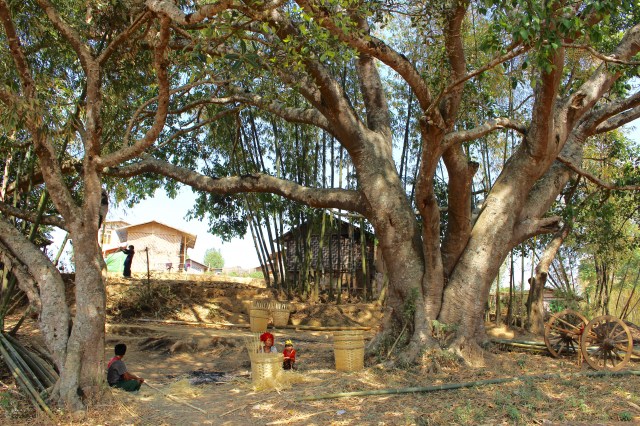
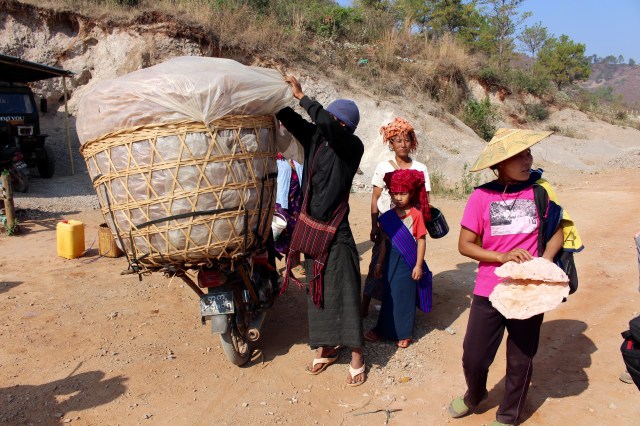
This was essentially a bamboo basket factory. The man in the back was stripping the bamboo, the boy in the foreground was cutting it into strips, and the woman and girl in the middle were weaving the strips into a basket. They make 5-6 baskets a day, and sell them at the market for about $1 each.This man was taking a huge basket of sesame rice cakes to market – Ma le bought some for the group to try.
There were 8 of us in total, Anaroos and Denise, two fun and hilarious Dutch gals, whip-smart Canelle, a French resident of London, Eli, a cautious and mildly cynical internationally-raised American, and Ma le, our Pa-O (local tribe) guide. The group talked a lot as we marched on, the order naturally rotating so that everyone got to chat and get to know each other. That is, except Eli, who liked to hang back, “in case of a charging bull or snake or other sort of emergency it feels safer in the back.” It was really great to trek with such lovely humans, and I feel so lucky we had such a wonderful group.
Ran into a spot of trafficThe crew checking out some mustard seeds
Making friends in the rice paddiesGroup shot
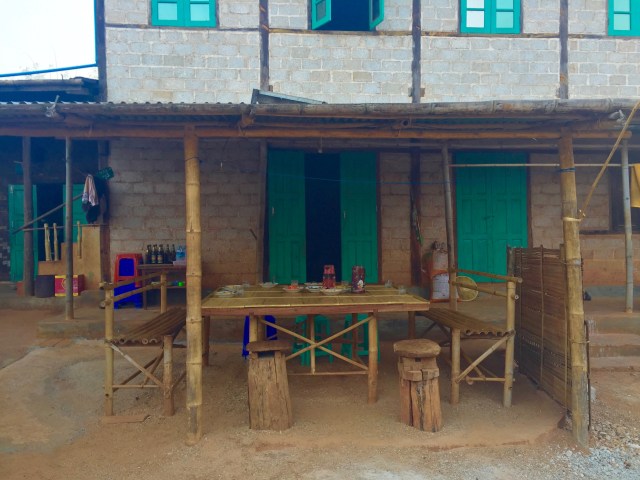
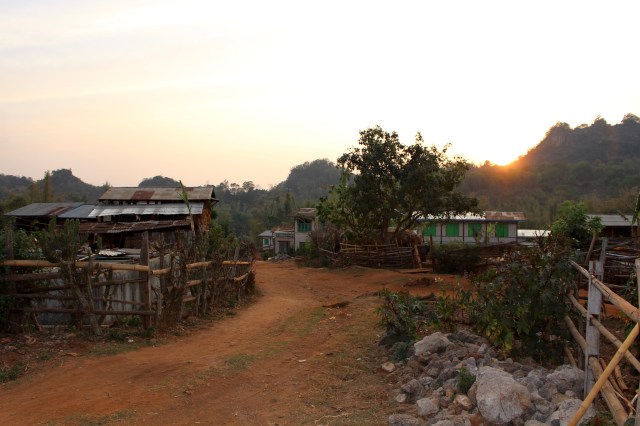
The homestay was interesting because we got to see first hand the economical impacts that trekking tourism has on an otherwise very traditional tribal community. We trekked past many villages with no running water, no electricity, everything as manual as it gets. (We saw men pounding cinder blocks into form, by hand, one by one.) When we arrived at our homestay, the town was booming. Every house had a larger guesthouse in some stage of development going up behind their original bamboo houses. Newly built outhouses and showers dotted side yards. They still didn’t have electricity, but our house had lightbulbs wired throughout which they connected to a car battery once it got dark. Kids were watching soccer games on their cell phones. Ma le told us that the trekking industry has brought these villages an amount of income they would have never been able to achieve via traditional agriculture, and the villagers are happy to welcome visitors.
Homestay VillageThese were our beds, simple blankets folded over bamboo flooring, all lined up in a rowOur breakfast nook
As we walked through the village before dinner her comments rang true, with cheerful greetings coming from the yards of our neighbors. Even so, I couldn’t help but worry about them – after hundreds of years of slow change and tribal living I fear the rapid onslaught of trekking groups will create some unintended side effects. That is all yet to be seen, but for now the trek –like Myanmar as a whole– is a wonderful and challenging adventure full of friendly locals eager to interact and share their culture.
Aleksiy, my lens cap and I enjoying the view from atop a medium size pagoda
No ’bout a doubt it – Bagan is one of the most extraordinary places I’ve ever been. We arrived at 7AM after a comical flight from Yangon (No name given or ID checked at the check-in counter, a sticker on our shirts indicated which flight we were taking, an old plane with an unnerving logo/tagline) and I was super stoked to come in with the sunrise and see dozens of hot air balloons floating all over the plain.
Tickets. No info on them
you’re safe with us
Happy to have survived
We rented electric scooters (E-bikes) from our hotel in Nyaung-U and spent most of the first day acclimating to our desert-like surroundings, getting our bearings straight, and testing the speed and terrain limitations of an electric scooter.
The following two days were spent zipping all over the dusty plain, aiming for and exploring any stupa/pagoda/temple that looked interesting.They allow you to climb on some and explore the upper levels of others, and sometimes we were completely alone at huge ancient pagodas. Each one had something unique to explore. Felt some real life Lara Croft/Indiana Jones exploration…add some temple-appropriate clothing and subtract the guns – but you get the point. It was awesome. By 1PM each day the temp got up to over 100°F, so we would go out early in the morning and come home midday to spend time by the pool in the afternoon.. Then, we’d go back out in the evening to explore some more and find some of the delicious vegetarian food that abounded in Bagan.
This slideshow requires JavaScript.
The night before our last day, I vowed to get some great photos of hot air balloons over the stupas. The balloons take off at dawn from different place each day, (location dependent on windspeed and other environmental factors) so they are kinda difficult to track down. Aleksiy and I got a bit of a late start, but had such a blast speeding over the plain, trying to get as close to the balloons as we could. Photos didn’t turn out that great (2 in the slideshow below), but the balloons were clear to the eye and magical as ever.








































 Tales of a Southeast Asian Invasion