I hadn’t heard about the Golden Triangle prior to researching our trip, but the conspiracies surrounding the area’s illicit history are super juicy. Geographically, the Golden Triangle is the three-country border between Thailand, Myanmar, and Laos. From the 1950’s to the early 90’s this area was the primary source of the world’s supply of heroin. The opium poppy was a cash crop for the region’s ethnic minorities, and the porous frontier was a perfect environment for processing and distribution. The opium was used to help finance their civil wars- in Myanmar this meant hill tribes fighting the central government, in Laos it was Hmong rebels and Royal Lao Government vs the Communist Pathet Lao .
As if that wasn’t juicy enough, some historians allege that the CIA was actually involved in opium drug trafficking here. Opium trade was legal in Laos until 1971; the name “the Golden Triangle” actually comes from a US State Department memo on the practice. Throughout 60’s and 70’s the CIA was sponsoring The Secret War in Laos, and several historians and veterans allege that US forces either participated in or turned a blind eye to Laotian forces using the drug to fund their operations. Some pop culture references: If you’ve seen the movie American Gangster, (an Hollywood version of real-life events), this is the region Frank Lucas got his pure heroin from. Marlon Brando’s Colonel Kurtz from Apocalypse Now is said to be inspired by real-life whacko Tony Poe, who was based in northern Laos during that time.
The Golden Triangle’s golden years have come and gone, but I did allow my imagination to search for any remaining clues of the once ubiquitous drug trade. The only evidence I found that might’ve stuck was this super haggard British guy that awkwardly joined our table at a cafe in Huay Xai. He was very thin and slurring his words, moving in slow motion. He mentioned that he’d spent the last 10 years cycling all over northern Laos. It’s a beautiful country, but I really don’t understand why one would do something like that – alone, for 10 years – unless something you were relentlessly addicted to was keeping you there. He was totally out of it and didn’t remember any of us the next morning (8 hours later re-introduced himself and started the same conversations). To be fair, he never mentioned anything, but in my gut I felt like this guy was on something.
I didn’t mean for this to be a sad or scary post; it is what it is. So much of traveling is taking the good with the bad, and it’s important to learn as much as you can about areas you’re traveling to. If you shelter yourself from the bad, the sad, or the hard to stomach, you’ll never get the whole story, you’ll fail to recognize suffering, and you could miss an opportunity to help. If you are aware of the problem it makes it so much easier to find people who are doing good things and support them; become a part of the solution, inspire hope, and help along the healing process.
We spent 12-13 days in Myanmar. Just like most countries in the region, Myanmar and its people haven’t had the best of times in the past. Colonization, civil wars, natural disasters and military oppression have all taken place in the past 150 years, making Myanmar one of the poorest countries in Asia and in the world. Military government had been in charge since the early 1960’s, ruling with an iron fist and performing genocide on multiple occasions.
We arrived when a huge political reform was taking place. There had been democratic elections and the National League for Democracy/the good guys had won with over 80% of the votes. They were to elect a president and a prime minister, change the old military laws and lead the country to better times! Easier said than done because the generals from the previous government, who are still powerful military leaders, wouldn’t let them change much.
Myanmar is an interesting place. It is very safe. It is packed with religious monuments. It is very hot and dusty. Standard of living is low. People are polite and genuine.
We got the feeling we were in a special place. A bit rough but very unique.We also got the feeling it wouldn’t stay the way we experienced it for long. All I mentioned above will probably make Myanmar a top tourist destination in the very near future. Millions of people will be going there, spending tons of money. Everything will change.
We arrived in Mandalay around 4:30AM fresh off a night bus from Inle Lake. We missed an opportunity to get off the bus near our hotel and ended up having to take a taxi back towards the center of the city. Our driver had a great command of English, so we arranged for him to pick us up in the morning and give us a day-long tour of the city before taking us to the airport that evening. After a nap and a shower at the cheapest hotel we could find, we were ready to go. We were surprised to see a completely different taxi driver waiting for us – he explained that our original hire couldn’t come because he had a date with his girlfriend (who knows; if it’s true, props to her for slaying).
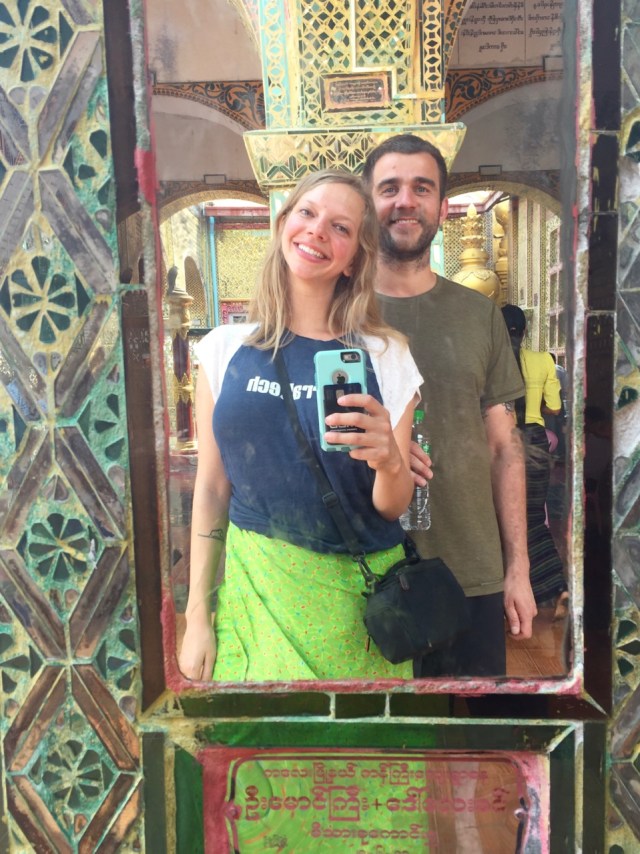
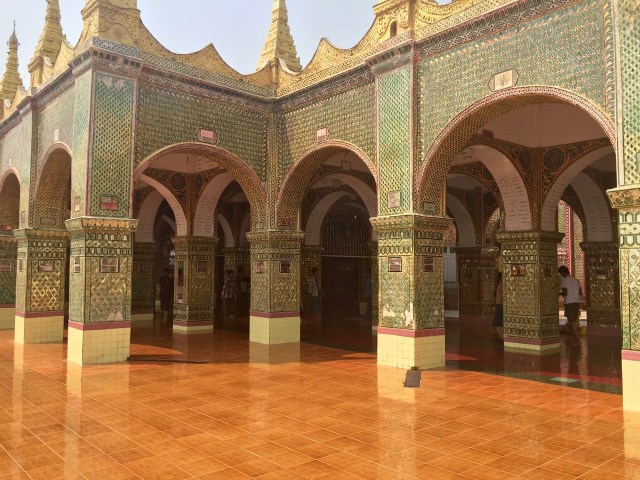
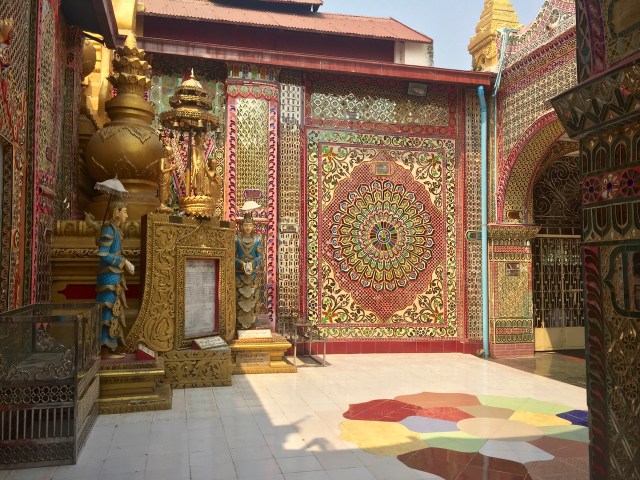
First stop was Mandalay Hill, the single giant bump on the flat plain that is Mandalay. At the top of the hill is Su Taung Pyi Pagoda, offering impressive views of the city below. I was unprepared for a Pagoda visit and unfortunately had to borrow a longyi, but was happy that I didn’t have to miss out on the views. (Sorry for no photos of the view, it was a dusty day and none of my photos looked that great)
Amazing longyi + amazing husband = happy girlPhoto doesn’t do it justice- the mosaic walls consisted of tiny little mirrors and this place was sparkling!Another gorgeous passageway
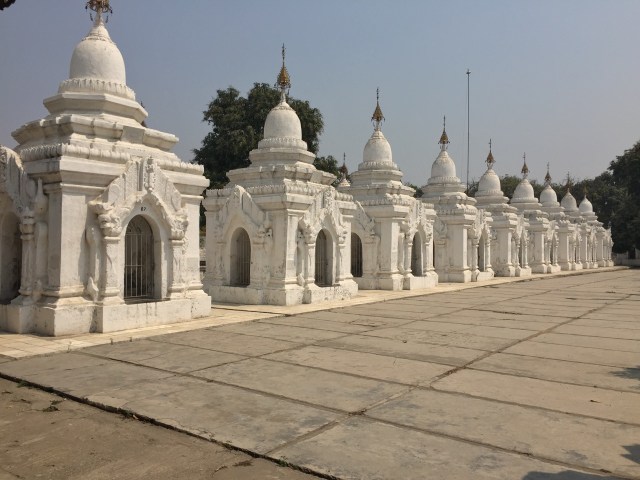
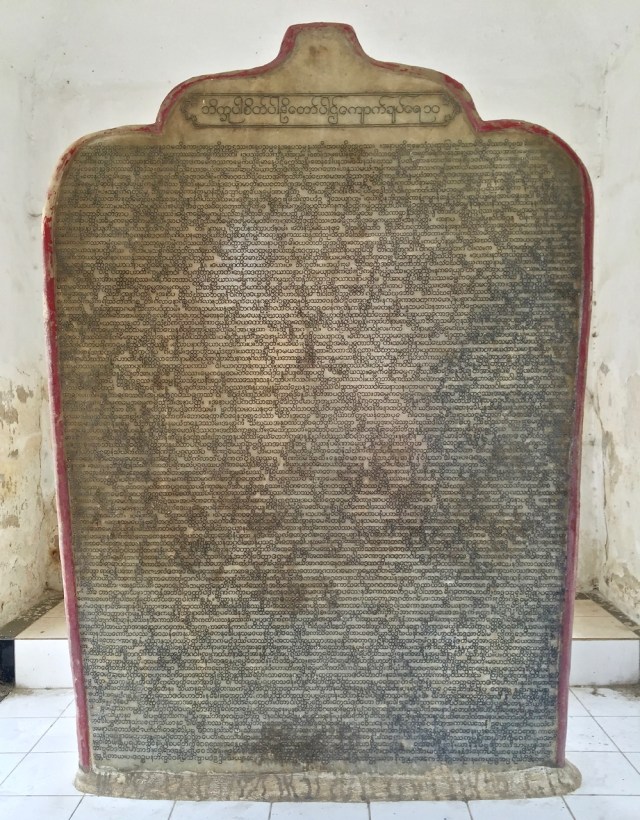
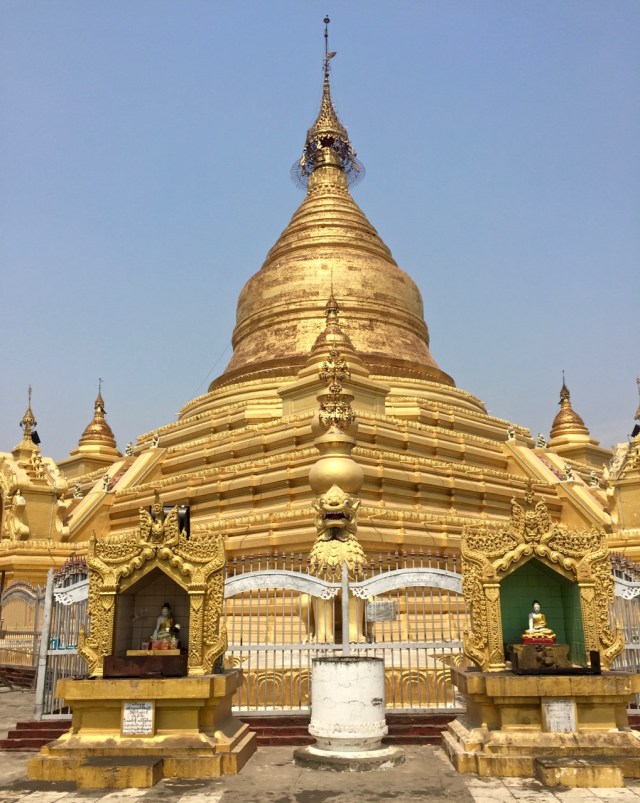
Next stop was Kuthodaw Pagoda, home of the Kuthodaw Inscription Scribes, a UNESCO World Heritage Site. The central stupa is surrounded by 729 mini temples, each containing a huge slab of marble inscribed with Buddhist scripture (the entire Tipitaka Pali Canon) in round squiggly Burmese script. The King of Burma had these commissioned in 1860 because he was worried that that the teachings of Buddha would be lost due invasion of the British. The slabs have been given the nickname the “world’s largest book” – however the Guinness Book of World Records would disagree.
Mini Temples housing the slabsA monk would carefully copy the text onto the marble, and then a stonemason would would chisel it out and fill it with gold leaf. It took a monk 3 days to finish a tablet (front and back) and a skilled stonemason could complete only 16 lines a day. When the British invaded, they did steal all the gold leaf out of the slabs, but the slabs remain.
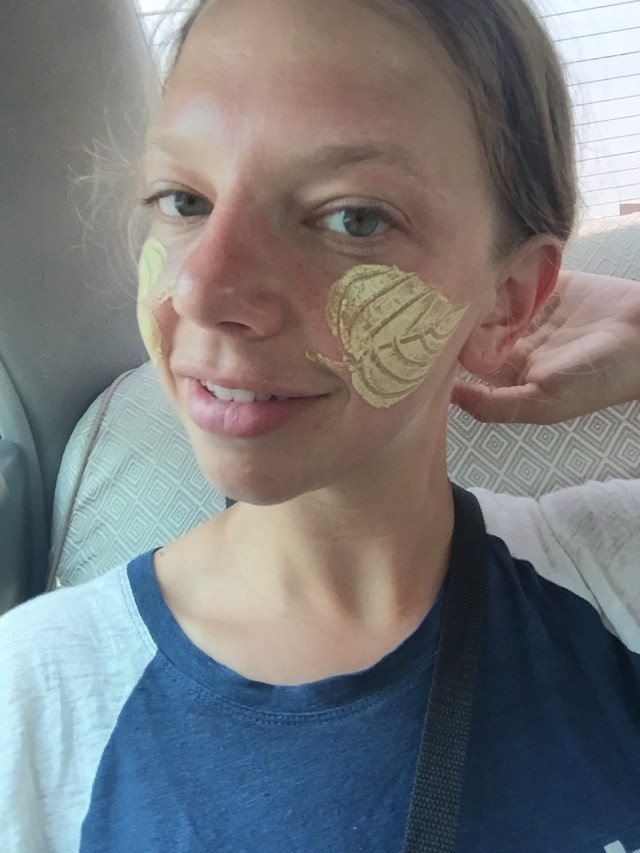
As we headed next door to the Sandamuni Pagoda, a sweet girl near the entrance offered to decorate my cheeks with some thanaka. Knowing that this was a gesture of kindness, I obliged and ended up with a sweet makeover for the day. The thanaka smelled great and felt cool in the heat, and I can totally understand why it was so popular and common among the locals.
The Sandamuni Pagoda features a huge golden stupa in the center, surrounded by thousands of smaller white stupas housing 1774 marble slabs inscribed with commentary on the Buddist scripture featured at Kuthodaw. They call this “Volume II of the World’s Largest Book,” and I found this space to be more peaceful and awe-inspiring than it’s more famous neighbor.
I really liked that tiger/dragon/dog thing that guarded the stupa
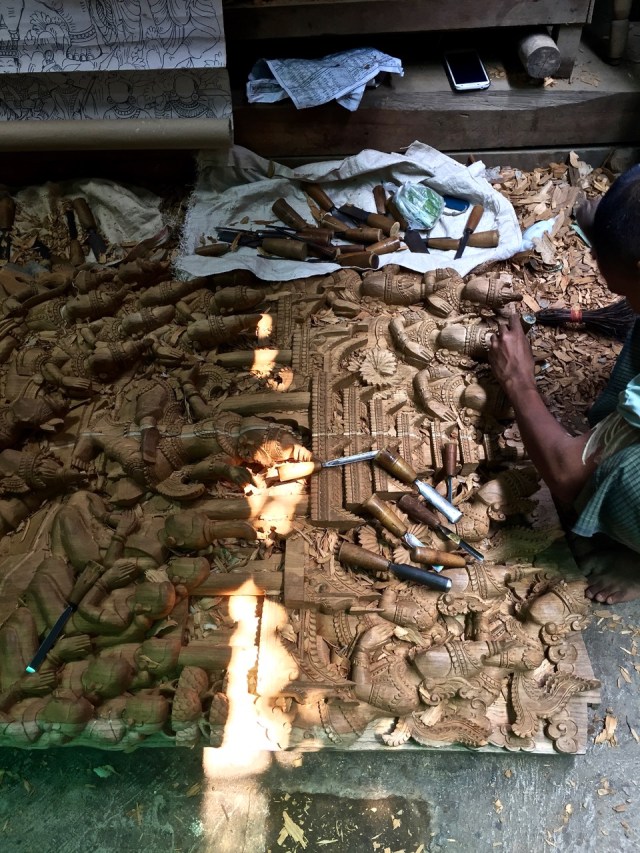
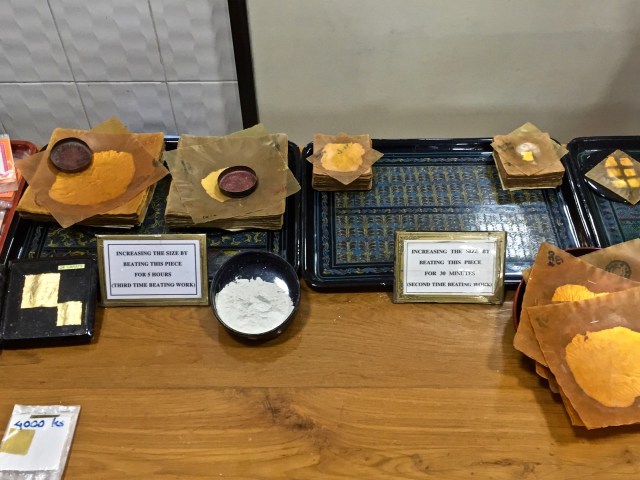
At this point in our journey Aleksiy and I were feeling stupa-d out, so we opted to visit some local workshops instead of more temples. We went to a textile workshop, a wood carving/tapestry workshop, and (my favorite) a gold leaf production site.
I like this photo because you can see the progress – the people in the bottom left corner have very little detail, while the people in the upper right are all blinged out – all using the simple tools he’s laid out
This was truly impressive – so gorgeous and all beaded by hand
In a lot of the temples/pagodas/stupas we visited, there were women selling little pieces of gold paper that we discovered to be gold leaf. People buy them and attach the gold foil to statues of Buddha as an offering. Here, we got to see how those little sheets of gold leaf were created.
They read right to left, so we must as well. They put a piece of gold foil the size of a fingernail unto the block at the far right, and pound it with a sledgehammer until it is the size of a silver dollar. Then, they cut that into 6 pieces…and beat each individual piece for another 30 minutes to make it a little larger than a silver dollar. Next, they beat it for 5 HOURS to press it to about the size of a small grapefruit. All in all, the gold gets hammered 3 different times, for 6 hours to make it thin enough to sell for a reasonable price – the little square in the bottom left of this photo is about $3.50USD
The last stop on our whirlwind tour of Mandalay was a visit to the “Bridge of Mandalay,” formally known as the U Bein Bridge. The bridge is about ¾ of a mile long, built around 1850, and is said to be the oldest and longest teakwood bridge in the world. That said, why we decided to walk back and forth across it remains a mystery, but I am glad we did it, because it was extremely entertaining.
First of all, Aleksiy and I are quite a bit larger than your typical Burmese person. Average height for a full grown male is 5’6” – I’m guessing average weight would be around 120. Lets just say the builders of the bridge were not considering Aleksiy and I.
The boards would rattle and shift as we picked our way across
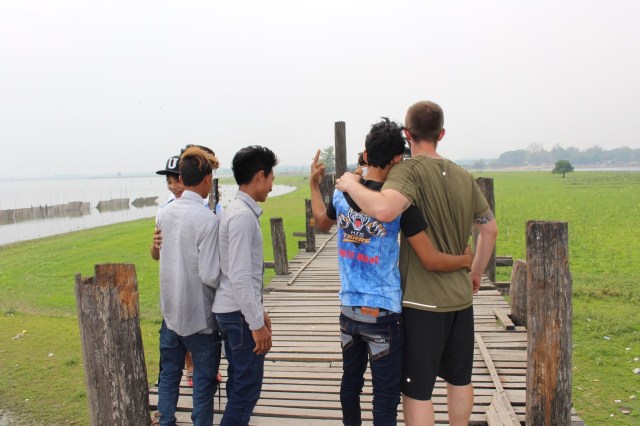
Second of all, walking the bridge (especially on a Sunday) is a decidedly popular local activity, and I really think we were the only foreigners out that day. We were asked to take photos with people not once, not twice, but FOUR TIMES. Especially Aleksiy, with his tattoos (or maybe just his handsome good looks)– people were fascinated. I was so entertained.
This was the first group to ask- first we thought they were asking our help taking a group shot, then we realized they wanted photos with Aleksiy… We thought perhaps he looked like a famous person we weren’t aware of, until it happened again…Fan club
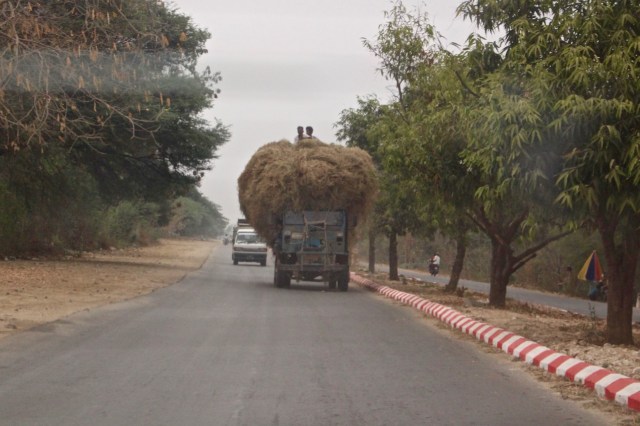
We made it back to the cab, not knowing whether to feel like celebrities or freak shows, and headed toward the airport. I have to say, this was probably the best way to do Mandalay, as everything is pretty spread out, it was 102 degrees, and the whole day tour only cost about $30. I was a little sad to be leaving the wild frontier that was Myanmar, but very much looking forward to a more modernized Chiang Mai – and a return to delicious thai food!
Traffic on the way to the airportNappin on the commute
Towards the end of our trek, I asked Ma le how much further (her answer was “1 hour”, every time) and she pointed to a shiny little triangle between two mountains and told me it was the lake. I figured something had gotten lost in translation, because what she was pointing at certainly wasn’t water. It was shiny and it glimmered like the tin roofs of the villager’s houses – I thought maybe she was pointing out our final destination, a village near the lake.
Long shallow boats docked beneath the stilt houses
As we got closer, I realized that Ma le WAS pointing at Inle Lake, and that the shiny glimmering rooftops were the roofs of houses built on the water, on stilts over the lake. After a final meal with our trek group, Ma le loaded us into a canoe-like motor boat and we zoomed north, to the village of Nyaung Shwe, where we would stay during our time at Inle.
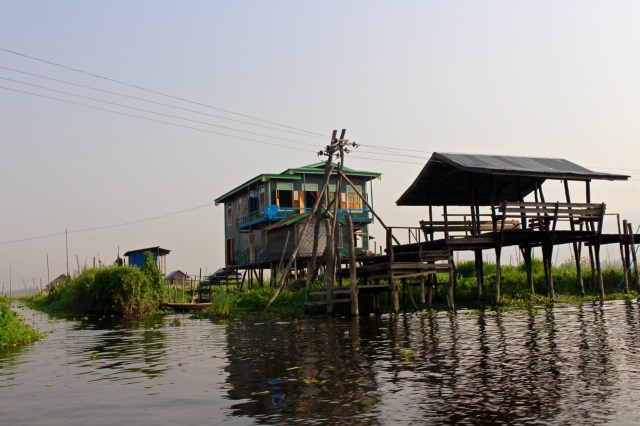
Inle Lake is a unique place. The lake itself is not very deep (average depth is only like 7 feet) and it’s clarity and fertile surroundings have encouraged villages to form and subsist upon the lake. Most of the villagers that inhabit the lake live in the stilt houses and have developed plots of floating gardens near their abodes. Fishing is also a source of income for the locals, as well as handicrafts like traditional textile weaving, ornamental carvings, and now, tourism. Most tourists stay in Nyaung Shwe, a city just north of the lake, easily accessible by boat. Accommodation on the lake itself is limited, expensive and isolating.
Typical standalone stilt house, with boats docked underneathA beautiful day in the neighborhoodThis was a cheroot storeBar & restaurant – just like the Ozarks!
The satellite on this house made me smile
I got to learn a lot more about life on the lake during a boat tour I took with Canelle and Wes, a friendly Canadian fellow we met in town. Luckily, Canelle had done her homework and knew what ask for when we were negotiating the itinerary with our boat guide. Apparently, there are several “fake” markets and unethical activities on the lake that exist for the sole purpose of tourists’ entertainment. For example, you can visit a “long-necked woman village” which is essentially a prop town where rural women of the Kayan tribe are on display for your viewing pleasure and a small entrance fee. The saddest part about it, is that the women don’t even live nearby so they are essentially taken from their village and stuck in a human zoo until they’ve made enough money to go back home. Skip that.
Our boat captain and his reluctant assistant
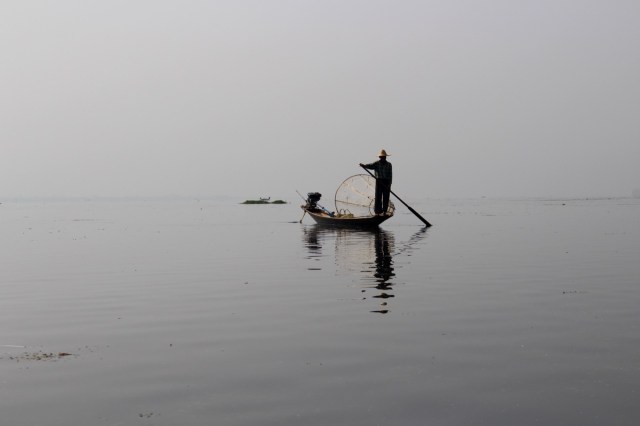
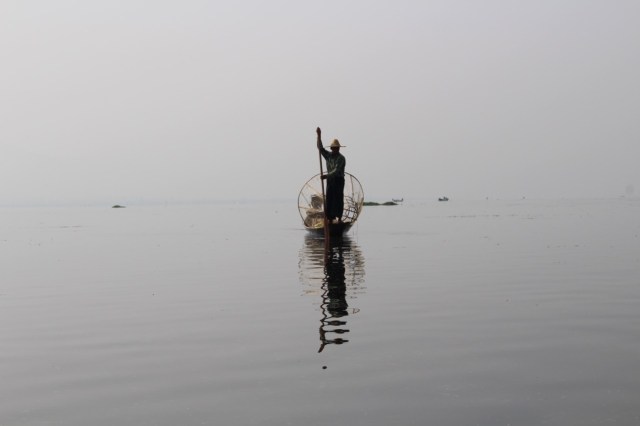
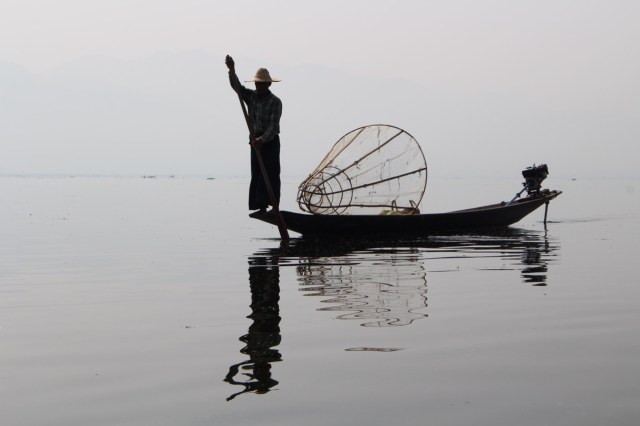
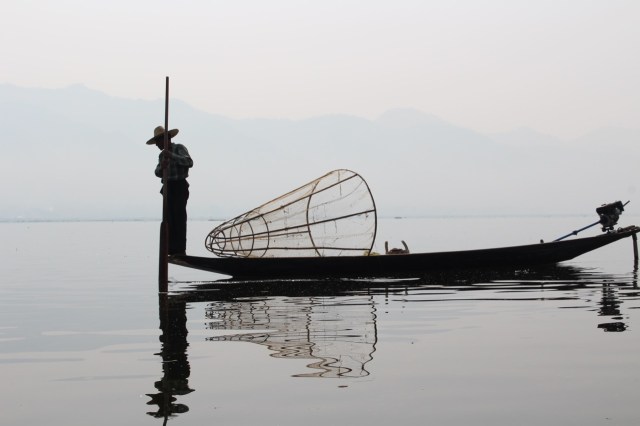
We set out early to watch the gorgeous process that is Inle’s traditional fishing methods, zooming past “fake fisherman” that dress the part and take tips for photos. The real deal is a mesmerizing sight– fisherman stand on the very tip of their canoe-like boats and paddle with one leg wrapped around an oar, while they slowly lower a basket into the water and trap the fish.
I have approx 100 photos of these guys
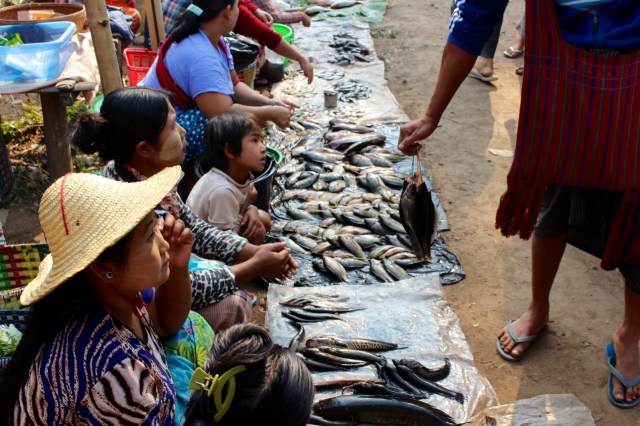
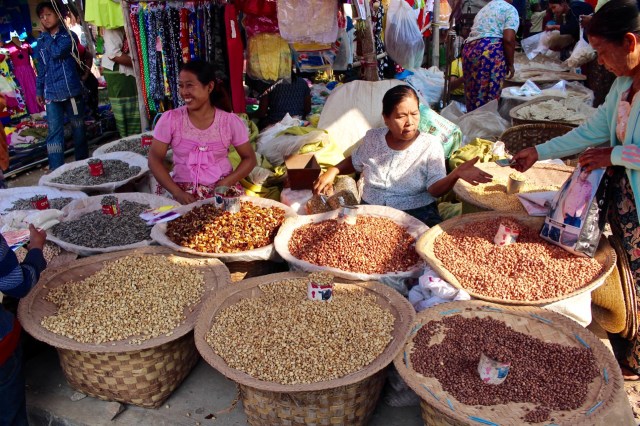
After excessive documentation of the fishing process, we moved on to the local market, which mostly featured food. You can tell pretty quickly if a market is genuine or not by the wares offered for sale. Some markets are full of tourist crap, which you begin to recognize very quickly because it’s for sale on every corner. Others, like this one, cater to the locals and are so much more interesting.
Some of these fish were still moving
Sometimes you feel like a nut, sometimes you don’t
After the market, our next stop was Tharkong Pagoda. The ride to the pagoda was harrowing- weaving through curvy canals in our 30ft boat, playing chicken with other boats while trying to thread the needle through the rudimentary canal locks. The first couple of times I was ass-clench terrified, after a couple successful passes I began to enjoy the rush – funny how that works.
Oh god… Oh no… too close too closeoh we’re gonna die, too fast, too tighttoo fast too fastgonna die gonna die*holding breath*Yay, you’re alive!
The entrance to the pagoda was a long hallway lined with hand-made items for sale: sand paintings, textiles, purses, wooden masks, puppets, etc. The walkway was so long we thought perhaps we weren’t headed in the right direction. The pagoda itself was immemorable, but the stupas surrounding the site were fun to explore. All in various states of restoration, it was like a mini Bagan. One can sponsor the restoration of a stupa; it was fun to search around for the English ones (there were only 2 or 3, most looked Burmese or Thai, but we did see some Chinese and Russian)
The boat jetty & charming town surrounding Tharkong PagodaApproaching the pagoda over the canalCanelle in the long hall of vendors
Snoozing PupsGreat place for hide & seekThe bells at the top of the stupas jingled softly in the breeze
Nature finds a way
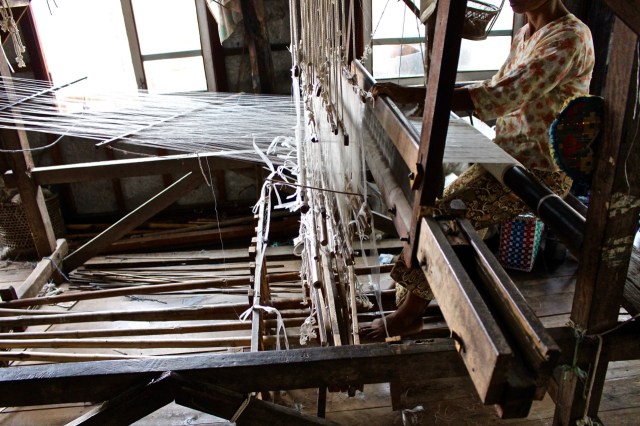
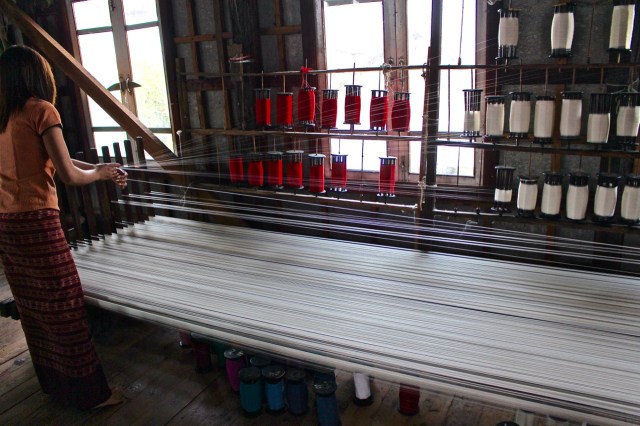
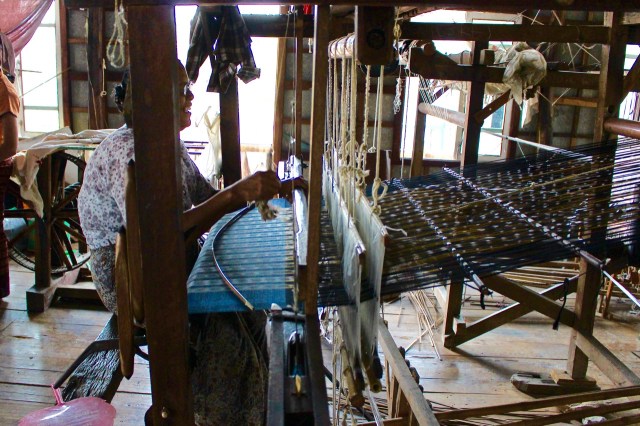
Our next stop was a textile factory. It was fascinating to see where lotus silk comes from – break a lotus twig in half and the gooey fibers are strong enough to be woven together to create thread. End product is incredibly soft (but v. expensive). We watched the women weave intricate patterns by hand, in awe of how quickly they were moving regardless of the tediousness of the process. They looked like they were playing an organ of wood and thread, with lots of pedals at their feet and strings of thread at their fingertips. As they pedaled, the big wooden bobbin clacked back and forth across the length of the loom, giving the warm room full of moving parts a rather hypnotizing quality.
So many moving parts
Preparing the thread for the loomAfter years of experience, these women were so quick & talented
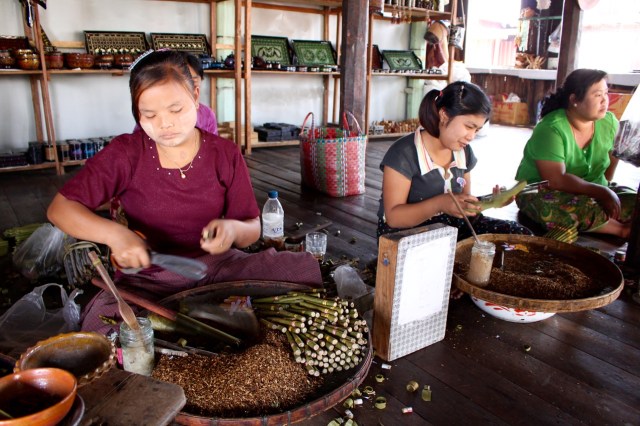
After a lackluster lunch on the lake, we moved onto a little shop where women were hand-rolling mini cigars- called cheroots. There are many different variations of a cheroot, but here you had a choice between sweet and full flavor. The sweet tobacco was delicious – flavored with honey, tamarind, brown sugar, banana, alcohol, salt, star anise & fennel seeds, it tasted similar to a clove cigarette.
Their boss promised me that school was on a holiday
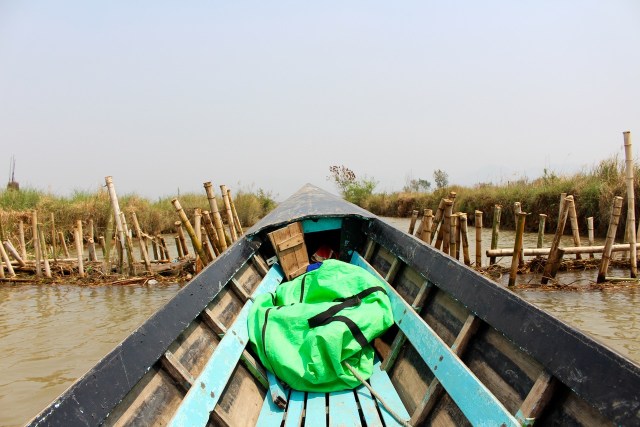
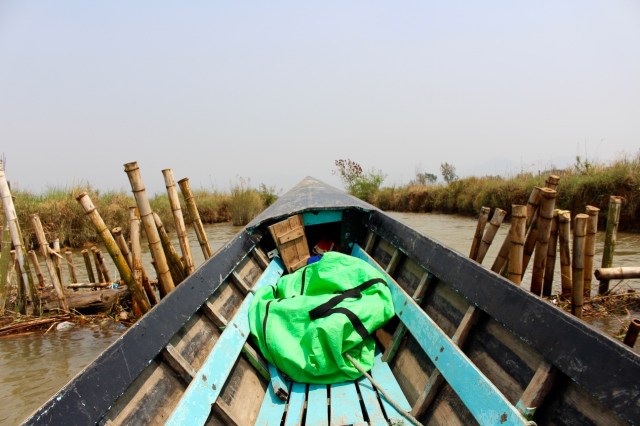
Our last stop on the way back to Nyaung Shwe was a drive-by of the floating gardens – a large community vegetable garden on the lake. We had previously seen farmers filling their boats to the brink with lake-bottom weeds, I figured it’s nutrient rich properties make great fertilizer. Here, our boat guide explained that the weeds are used to form the floating garden beds, anchored in place by bamboo poles. The gardens are able to rise and fall with the water level, totally resistant to flood and drought. Depending on the season, they can grow tomatoes, cucumbers, squash and eggplant, plus an assortment of beans and lentils.
Rice paddies on a shallower part of the lakeThey had to start bailing out that boat– it was sinking with the weight of the lake weedTo the brimFarmer tending to her rows of veggie bedsFarmers laying down more tomato beds
We probably (Aleksiy would say definitely) allocated too much time for our visit to Inle, as there’s not much to do there aside from exploring the lake, which you can really do in 1 day. That said, Canelle, Aleksiy and I did ride bicycles to a nearby vineyard for a sunset wine tasting on the patio. Although the wine was a joke, the views and company were great – all in all a lovely time in Inle Lake.
From Bagan we flew to Heho, the airport closest to our next stop: Inle Lake. There are a couple of ways you can get to Inle from Heho; you can take an hour-long taxi directly there, OR you can take an hour-long taxi the opposite direction to a town called Kalaw, and spend 2 to 3 days trekking in from there. (Trekking = hiking; no one says hiking) We had heard from several other travelers that this was an amazing experience not to be missed, so we rearranged our plans a bit and made it work.
Kalaw is a very small town not known for much other than it’s trekking businesses. There are some pretty views, a weekly farmers market and a good restaurant, but that’s about it. We killed some time at the market, shopped around at different trekking companies, and got to know Marc, the Belgian proprietor of our B&B. Marc is super intelligent (engineered an eco-friendly water filtration and plumbing system for the B&B) and has had a ton of interesting life experiences (spent a large portion of his life working at non-profit NGOs all over the world), but I loved him most because he made his own yogurt, banana bread, and jams from local fruits. Obviously culinary skills are the way to my heart.
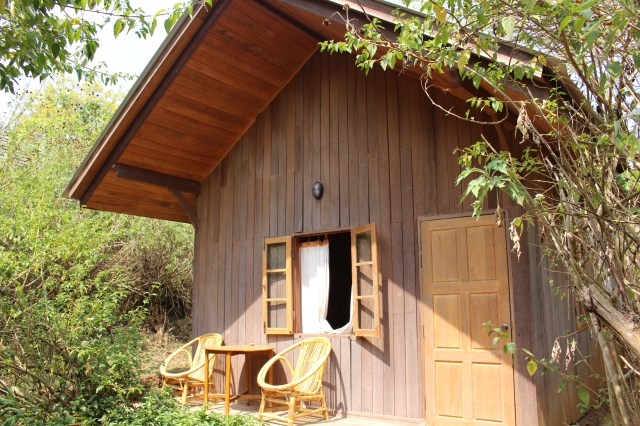
Our little bungalow at Marc’s Thitaw Lay House in Kalaw
Anyhow – there are a number of different trekking routes between Kalaw and Inle Lake, but the one we chose was 2 days, 1 night and 32 miles in length — 17 miles the first day, 15 miles the second, with an overnight homestay in a tribal village. The first day began around 8AM, with a mid-morning stop to meet a woman from a local tribe and watch her weave a handbag. We lunched at another village around 1PM, stopping for an hour (30 minutes we ate, 30 minutes we napped). The rest of the afternoon we trekked, arriving at our homestay village around 5PM.
Tribal woman weaving purses by hand – each purse takes 8 hoursLittle sweetie welcoming us in for lunch – her house was made entirely of bambooBamboo ladder inside the home
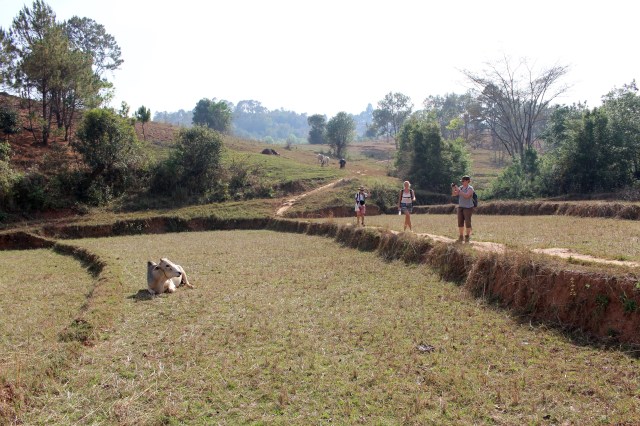
The terrain was primarily farm land, but much different than what Nebraska & Iowa offer. We walked along a tall ridge, each slope as far as the eye can see parceled out into different types of vegetation, and farmers out in the fields doing everything manually. We saw a lot of ginger, sweet potato, turmeric, and of course RICE on RICE on RICE on RICE. We saw men mining limestone to use for their betel chews. Along the way, our guide Ma le (sounded like “Molly”) would offer facts on what was growing, how things were planted, and other interesting tidbits on Burmese agricultural methods. Aleksiy stuck close to Ma le and asked a ton of questions, which the whole group was grateful for.
This slideshow requires JavaScript.
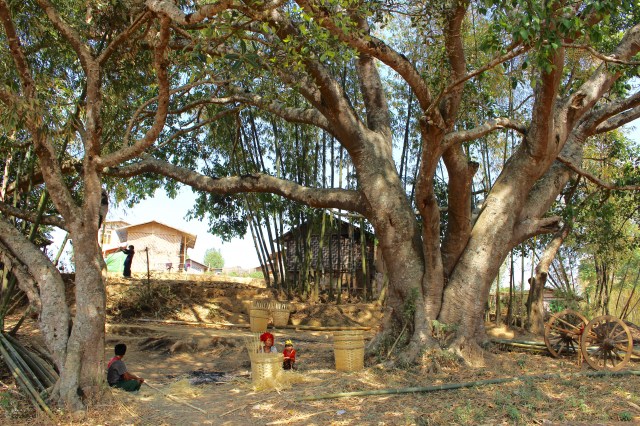
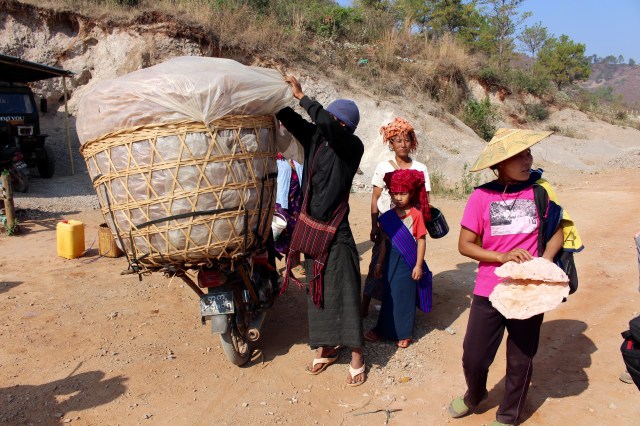
This was essentially a bamboo basket factory. The man in the back was stripping the bamboo, the boy in the foreground was cutting it into strips, and the woman and girl in the middle were weaving the strips into a basket. They make 5-6 baskets a day, and sell them at the market for about $1 each.This man was taking a huge basket of sesame rice cakes to market – Ma le bought some for the group to try.
There were 8 of us in total, Anaroos and Denise, two fun and hilarious Dutch gals, whip-smart Canelle, a French resident of London, Eli, a cautious and mildly cynical internationally-raised American, and Ma le, our Pa-O (local tribe) guide. The group talked a lot as we marched on, the order naturally rotating so that everyone got to chat and get to know each other. That is, except Eli, who liked to hang back, “in case of a charging bull or snake or other sort of emergency it feels safer in the back.” It was really great to trek with such lovely humans, and I feel so lucky we had such a wonderful group.
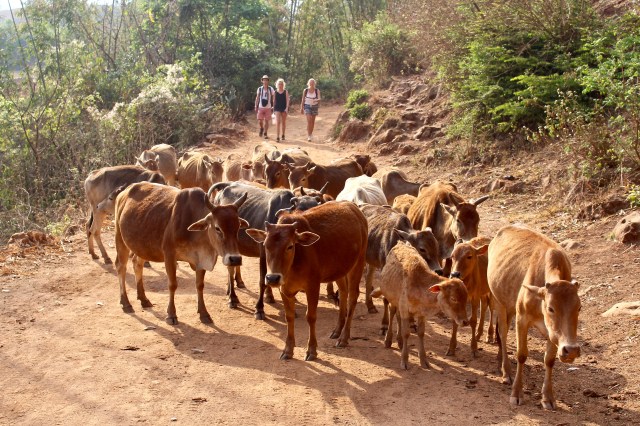
Ran into a spot of trafficThe crew checking out some mustard seeds
Making friends in the rice paddiesGroup shot
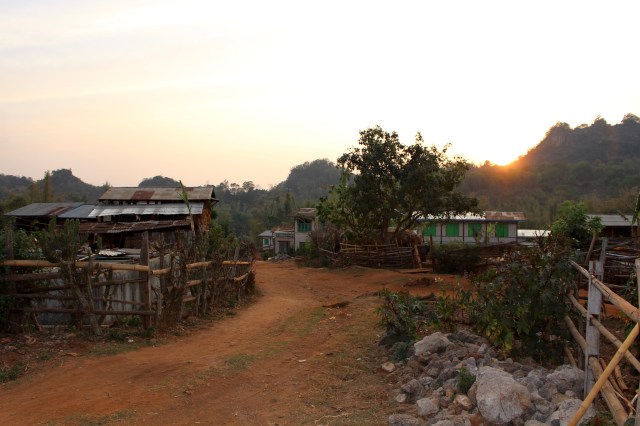
The homestay was interesting because we got to see first hand the economical impacts that trekking tourism has on an otherwise very traditional tribal community. We trekked past many villages with no running water, no electricity, everything as manual as it gets. (We saw men pounding cinder blocks into form, by hand, one by one.) When we arrived at our homestay, the town was booming. Every house had a larger guesthouse in some stage of development going up behind their original bamboo houses. Newly built outhouses and showers dotted side yards. They still didn’t have electricity, but our house had lightbulbs wired throughout which they connected to a car battery once it got dark. Kids were watching soccer games on their cell phones. Ma le told us that the trekking industry has brought these villages an amount of income they would have never been able to achieve via traditional agriculture, and the villagers are happy to welcome visitors.
Homestay VillageThese were our beds, simple blankets folded over bamboo flooring, all lined up in a rowOur breakfast nook
As we walked through the village before dinner her comments rang true, with cheerful greetings coming from the yards of our neighbors. Even so, I couldn’t help but worry about them – after hundreds of years of slow change and tribal living I fear the rapid onslaught of trekking groups will create some unintended side effects. That is all yet to be seen, but for now the trek –like Myanmar as a whole– is a wonderful and challenging adventure full of friendly locals eager to interact and share their culture.
Aleksiy, my lens cap and I enjoying the view from atop a medium size pagoda
No ’bout a doubt it – Bagan is one of the most extraordinary places I’ve ever been. We arrived at 7AM after a comical flight from Yangon (No name given or ID checked at the check-in counter, a sticker on our shirts indicated which flight we were taking, an old plane with an unnerving logo/tagline) and I was super stoked to come in with the sunrise and see dozens of hot air balloons floating all over the plain.
Tickets. No info on them
you’re safe with us
Happy to have survived
We rented electric scooters (E-bikes) from our hotel in Nyaung-U and spent most of the first day acclimating to our desert-like surroundings, getting our bearings straight, and testing the speed and terrain limitations of an electric scooter.
The following two days were spent zipping all over the dusty plain, aiming for and exploring any stupa/pagoda/temple that looked interesting.They allow you to climb on some and explore the upper levels of others, and sometimes we were completely alone at huge ancient pagodas. Each one had something unique to explore. Felt some real life Lara Croft/Indiana Jones exploration…add some temple-appropriate clothing and subtract the guns – but you get the point. It was awesome. By 1PM each day the temp got up to over 100°F, so we would go out early in the morning and come home midday to spend time by the pool in the afternoon.. Then, we’d go back out in the evening to explore some more and find some of the delicious vegetarian food that abounded in Bagan.
This slideshow requires JavaScript.
The night before our last day, I vowed to get some great photos of hot air balloons over the stupas. The balloons take off at dawn from different place each day, (location dependent on windspeed and other environmental factors) so they are kinda difficult to track down. Aleksiy and I got a bit of a late start, but had such a blast speeding over the plain, trying to get as close to the balloons as we could. Photos didn’t turn out that great (2 in the slideshow below), but the balloons were clear to the eye and magical as ever.
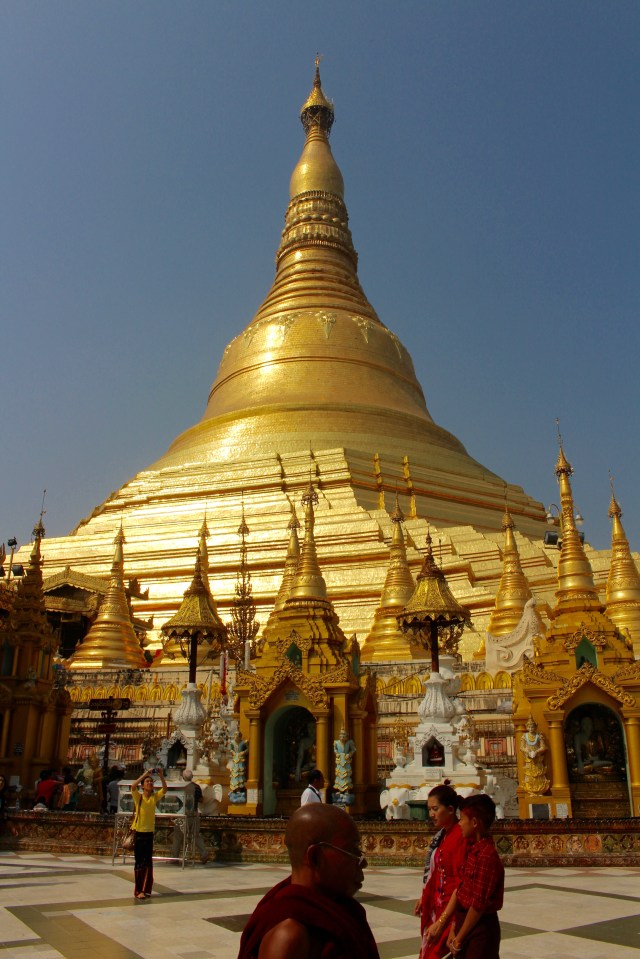
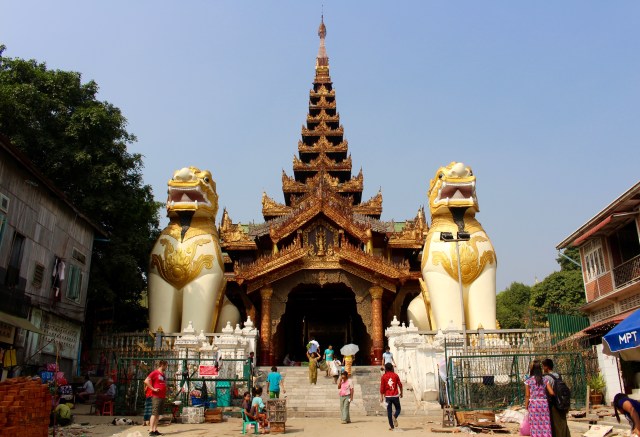
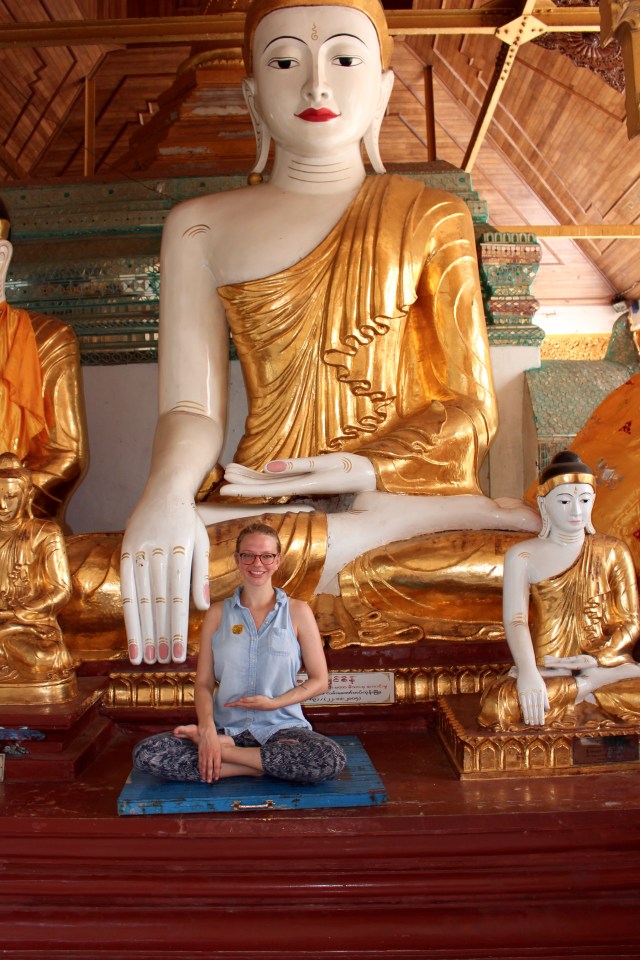
The crown jewel of Yangon is Shwedagon Pagoda, a gigantic gilded stupa centered in a big plaza of pagodas and temples, at the top of the highest hill in Yangon. The back of our entrance ticket (only foreigners pay, 8,000 kyat = ~$6.50) said that top of the stupa is tipped with 5,448 diamonds and 2,317 rubies, and the very top—the diamond bud—is a 76 carat diamond. It is an impressive sight, with grandiose entrances at each cardinal direction. We entered from the east, and departed that way as well, so Aleksiy could return the borrowed longyi he was asked to wear.
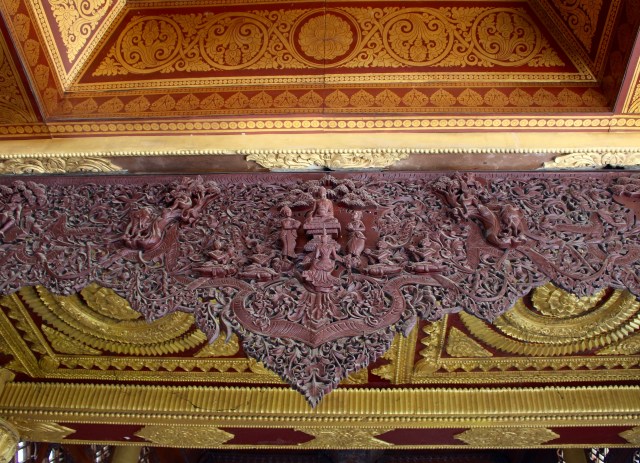
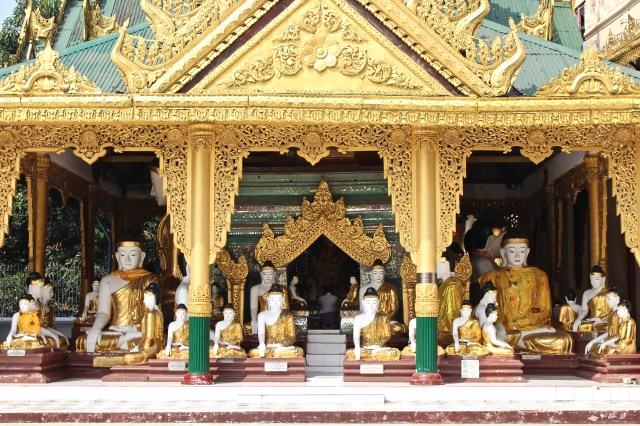
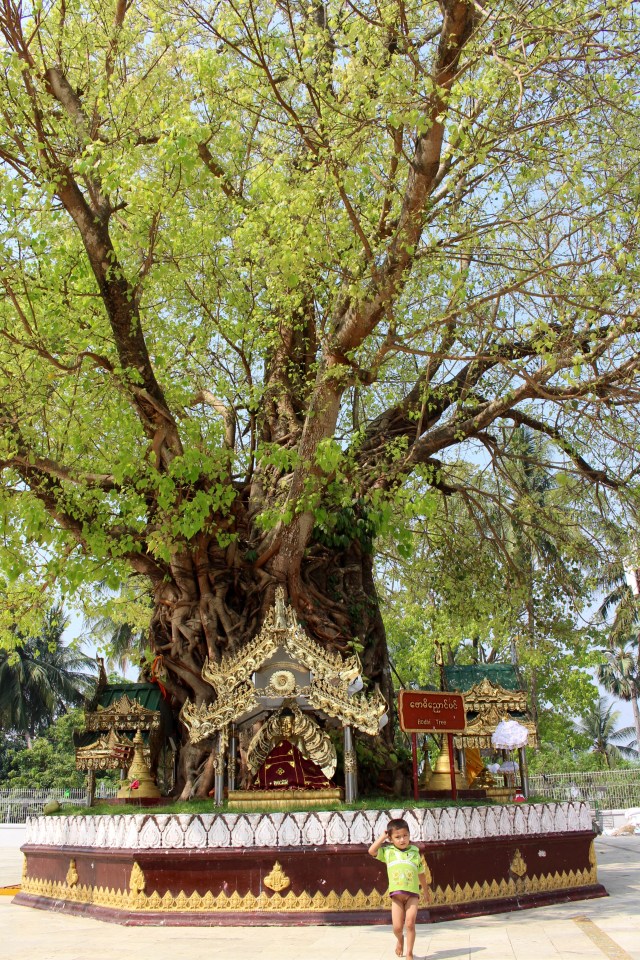
East entrance – two city blocks below the plaza, you walk up two long sets of stairs to get to the topInside the multi-roofed hall is the second set of stairs you walk up to enter the plaza at the topOrnate carvings hung at intervals from the ceiling of the eastern entrance hall. Tons of merchants lined the hall, selling everything from malas, candles, and strings of flowers to live caged birds for people leave behind as offerings within the temples in the plaza.Inside the plazaAn entrance to one of the many pagodas in the plazaA sacred Bodhi Tree growing in the plaza. Buddhists believe that Siddharta Gautama attained enlightenment under a Bodhi tree (becoming Buddha) and now these trees are planted near every Buddhist monastery. This little half naked boy acted as our unofficial tour guide for a good 20 minutes or so – pulling us around pointing at things. No idea who he belonged to or why he had no pants on, but he didn’t seem lost or scared so I let him get on with his pooh bear swag.Reclining Buddha and a smaller golden Buddha surrounded by monks in one of the pagodasOh hey, just sittin how I always sit.Get a load of that sweet dragon… or chinthe …or leogryph….
Every holy place we’ve visited has requested that we leave our shoes+socks at the entrance and wear clothing that covers our knees and most of our shoulders. We are more than happy to oblige out of respect for holy places and worshiping Buddhists, but the heat (over 100F), hot stone, and lack of viable wardrobe options doesn’t make it easy. Aleksiy thought he could get by with his shorts, but alas, his big white knees betrayed him again -they are always getting him into trouble. I’m not going to say the highlight of the day was watching him sashay through the plaza, but it was truly a sight to behold.
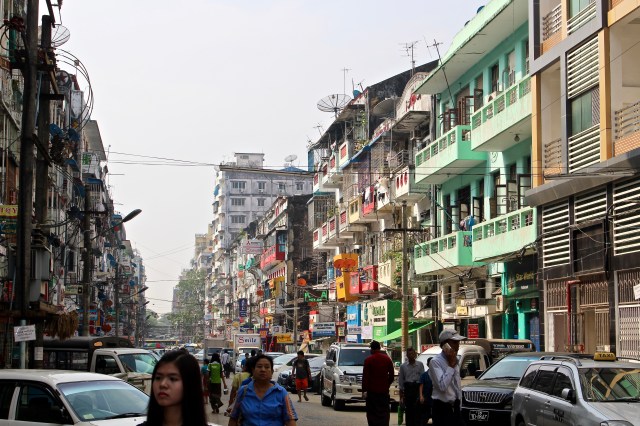
We spent the first full day wandering towards/by/thru interest points in downtown Yangon. It was hotter than hell, at one point we let our HANGER get the best of us, but it felt amazing to get lost in such a bustling, different city.
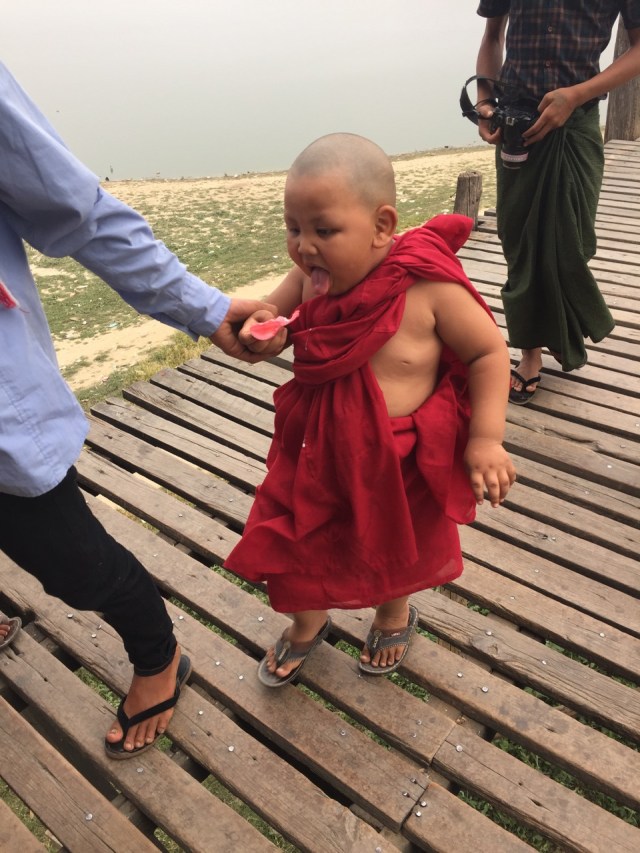
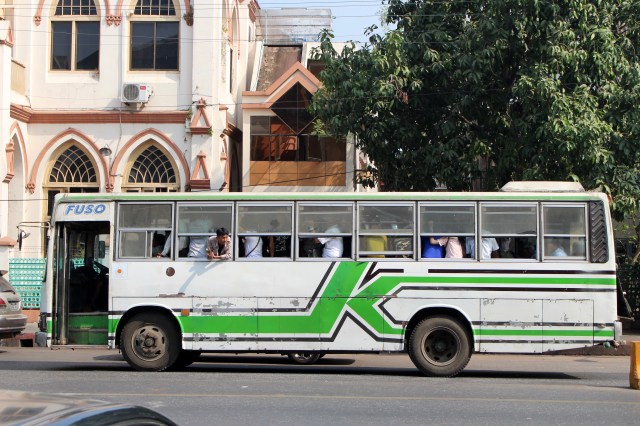
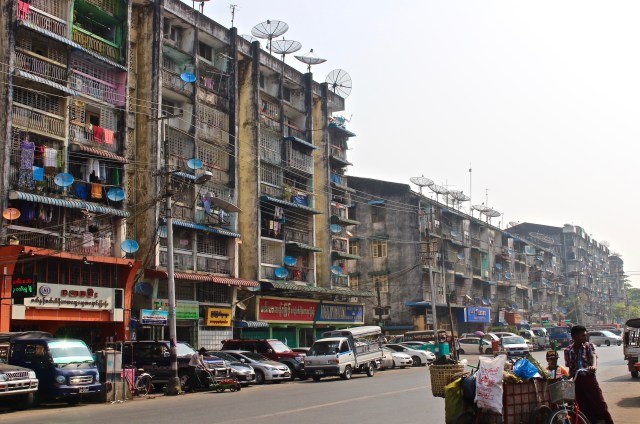
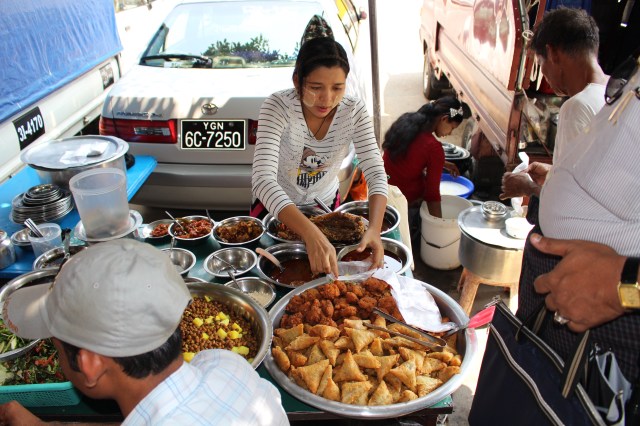
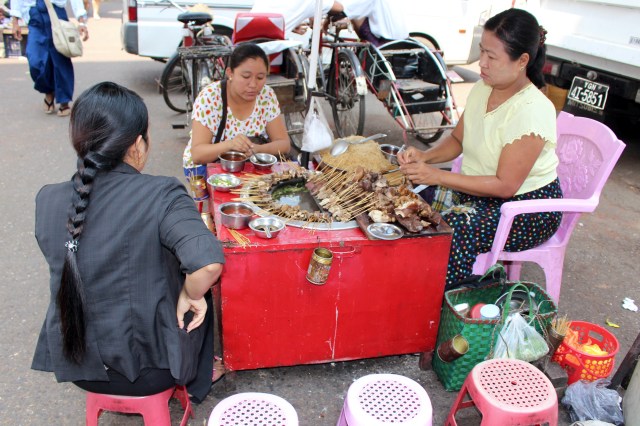
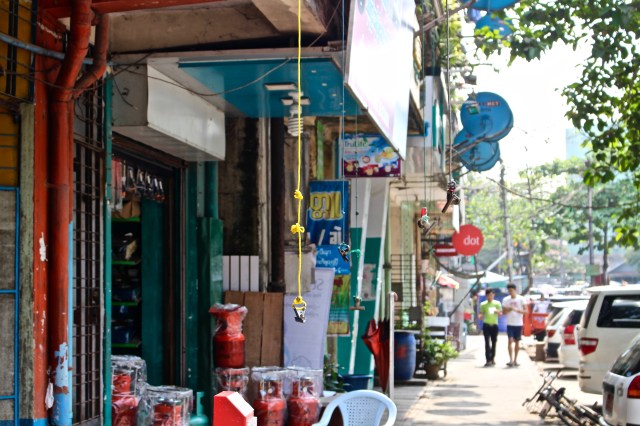
Mini-monks on their morning alms route. “Every Buddhist Burmese boy between the age of 7 and 13 is expected to enter the monastery as a novice monk for a period of a few weeks to several months. He has a choice to return to life outside the monastery at any time, or he can stay on as a monk, if he so chooses.” Read more on monks of Myanmar hereTypical side street in downtown YangonLocal BusA look down Anawrahta RoadThere were stands like this on every corner. The man takes a betel leaf, brushes slaked lime on it (limestone heated & mixed with water), adds some crushed betel nut, tobacco and other spices such as cinnamon or nutmeg, whatever the customer orders. He then wraps the leaf into a bitesize little packet so that the consumer can chew it like chewing tobacco. Something in it turns their saliva and teeth a muddy red color, and they have to spit a lot. The first time I saw it I thought people were spitting blood. It’s very common, said to give the user tons of energy , but also extremely carcinogenic. We passed on it. Read more on betel nut hereTypical food vendor – the samosas were a favorite of ours because most were meat-free (read: safe) and stuffed with flavorful potatoes, peas, sometimes minced onion. The vendor is wearing thanaka on her cheeks – a common cosmetic, seen on everyone from children to teen boys to women of all ages. Read more on thanaka here.Also a common sight, this looked and smelled delicious and had we not been afraid of gastrointestinal ramifications we would’ve joined the table. The woman in the yellow shirt is selling various types of meat on sticks to the people that join her at the table. There is a pit of meat juice and once you select your meat bite you could dip it in there and/or enjoy it with any of the other many condiments at the table. We weren’t quite sure what types of meat were for sale here, but Aleksiy guessed it was everything from chicken thigh to organ meat. This made me laugh. I had no idea why there were so many ropes dangling from the top of these apartment buildings, but Aleksiy knew that they were for the tenants above to quickly transact exchanges with the people on the sidewalk below. We later saw one in action, a delivery man attached a small bag of food to the rope and up it went.
(The following information is taken directly from wikipedia)
Chinlone is the traditional sport of Burma (Myanmar). Chinlone is a combination of sport and dance, a team sport with no opposing team. In essence chinlone is non-competitive. The focus is not on winning or losing, but how beautifully one plays the game.
A team of six players pass the ball back and forth with their feet, knees and heads as they walk around a circle. One player goes into the center to solo, creating a dance of various moves strung together. The soloist is supported by the other players who try to pass the ball back with one kick. When the ball drops to the ground it is dead, and the play starts again.
Chinlone means “basket-rounded or rounded basket ” in Burmese. The ball is woven from rattan, and makes a distinctive clicking sound when kicked that is part of the aesthetic of the game. Players use six points of contact with the ball: the top of the toes, the inner and outer sides of the foot, the sole, the heel, and the knee. The game is played barefoot or in chinlone shoes that allow the players to feel the ball and the ground as directly as possible. The typical playing circle is 6.7 metres (22 ft) in diameter. The ideal playing surface is dry, hard packed dirt, but almost any flat surface will do.
Chinlone is over 1,500 years old and was once played for Burma royalty. Over the centuries, players have developed more than 200 different ways of kicking the ball. Many of the moves are similar to those of Burma dance and martial art. Some of the most difficult strokes are done behind the back without seeing the ball as it is kicked. Form is all important in chinlone: there is a correct way to position the hands, arms, torso, and head during the moves. A move is considered to have been done well only if the form is good.
Burma is a predominantly Buddhist country, and chinlone games are a featured part of the many Buddhist festivals that take place during the year. The largest of these festivals goes on for more than a month with up to a thousand teams. An announcer calls out the names of the moves and entertains the audience with clever wordplay. Live music from a traditional orchestra inspires the players and shapes the style and rhythm of their play. The players play in time to the music and the musicians accent the kicks.
Both men and women play chinlone, often on the same team. Adults and children can play on the same team, and it is not unusual to see elders in their 80s playing.
Yangon is the capital of Myanmar (Burma) and the country’s largest city. We arrived around 9PM and the city was already dark. I arranged for the hostel to pick us up from the airport because I didn’t want to worry about bartering for a taxi ride. I wasn’t sure what a fair fare would be and I was concerned they wouldn’t understand the address I had, which was written in English.
The culture shock was immediate. I went to the airport bathroom and in the first stall was a little girl that looked like she was 9, on her hands and knees in flip-flops scrubbing the squatty potty hole. Seeing someone on the ground that close to one of those portals to hell, without gloves or a mask or her hair tied back, made me forget that I even had to go and I 180-d the hell out of there.
The employee picking us up from the airport was a polite and soft-spoken kid named Gosu, he told us he was 24 but I would have guessed 17. As we drove home from the airport on barely lit streets, I stared out the window and began to get kind of nervous about my surroundings. Everything was really dark, but the storefronts that were lit were dusty and ramshackle.
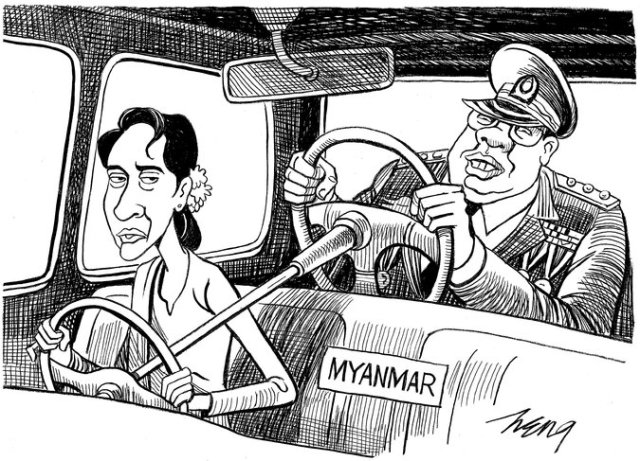
As we approached downtown Yangon, Gosu’s car was stopped by a handful of soldiers standing in the street. Without a word, one of them opened the front two car doors, examined Gosu and the front passenger’s seat with a flashlight, shut the doors and waved us on. As painless as it was, I was incredibly unnerved. Gosu apologized and said that they just started doing that, due recent changes in government. (Read more about that here)
Cartoon taken from NYTimes
Once we arrived at our hostel, I was relieved to see groups of tourists sitting on the patio drinking and chatting. A boy that looked younger than Gosu grabbed my bag and schlepped it up to our room. The official working age in Myanmar is 12 but the people look 30% younger than they really are, so at first glance it looked like the place was being run by a bunch of 8-12 year olds.
I sat on the bed and wondered what the hell I had gotten us into, thankfully Aleksiy interrupted my downward spiral and suggested that we go downstairs to get a drink.
We joined a table of Germans and Indians chatting in English, sharing a bottle of Johnny Walker. All of the Germans (except for 1, Jeremiah (?)) had to leave in the morning so they cleared out early. What ensued was a really fun night of incredible conversation spanning family, religion, politics, Myanmar, and cultural differences.
I’ll tell you about the Indians because they were my fave, although I can’t remember their names. They were 2 brothers from Punjab, one was ~55, the other ~60+. They were the bookends of 6 siblings, the only 2 still living. The younger one did most of the talking (great jokes!), and it was fascinating getting to know both them. The younger is a general practice doc, went to med school in England and lives there now with his English wife and daughter nearby (who recently birthed his first grandchild!) The older still lives in India, is a psychiatrist and a practicing Sikh, with lots of adult kids and grandchildren. He has a snow white beard that looked awesome with his dark skin, black turban, and huge smile. Towards the end of the night he was kind enough to take off his turban so I could see what was under there. To my delight he was sporting a the cutest snow-white top knot! We all laughed and I told him how stylish his hairstyle was.
We ended up polishing off the bottle of whiskey, and I fell asleep happy, grateful, and excited to be in Myanmar.





































 Tales of a Southeast Asian Invasion