

From Bagan we flew to Heho, the airport closest to our next stop: Inle Lake. There are a couple of ways you can get to Inle from Heho; you can take an hour-long taxi directly there, OR you can take an hour-long taxi the opposite direction to a town called Kalaw, and spend 2 to 3 days trekking in from there. (Trekking = hiking; no one says hiking) We had heard from several other travelers that this was an amazing experience not to be missed, so we rearranged our plans a bit and made it work.
Kalaw is a very small town not known for much other than it’s trekking businesses. There are some pretty views, a weekly farmers market and a good restaurant, but that’s about it. We killed some time at the market, shopped around at different trekking companies, and got to know Marc, the Belgian proprietor of our B&B. Marc is super intelligent (engineered an eco-friendly water filtration and plumbing system for the B&B) and has had a ton of interesting life experiences (spent a large portion of his life working at non-profit NGOs all over the world), but I loved him most because he made his own yogurt, banana bread, and jams from local fruits. Obviously culinary skills are the way to my heart.
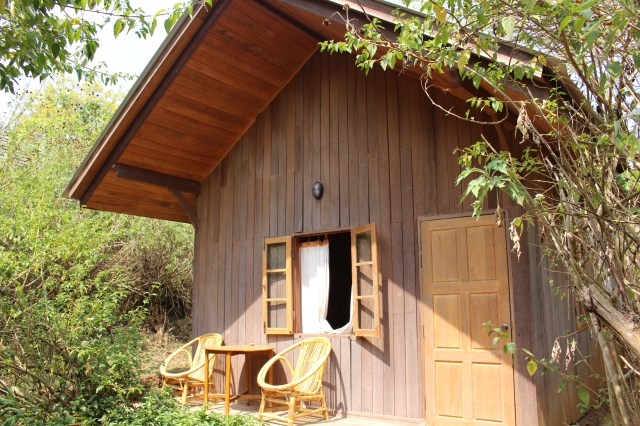
Anyhow – there are a number of different trekking routes between Kalaw and Inle Lake, but the one we chose was 2 days, 1 night and 32 miles in length — 17 miles the first day, 15 miles the second, with an overnight homestay in a tribal village. The first day began around 8AM, with a mid-morning stop to meet a woman from a local tribe and watch her weave a handbag. We lunched at another village around 1PM, stopping for an hour (30 minutes we ate, 30 minutes we napped). The rest of the afternoon we trekked, arriving at our homestay village around 5PM.


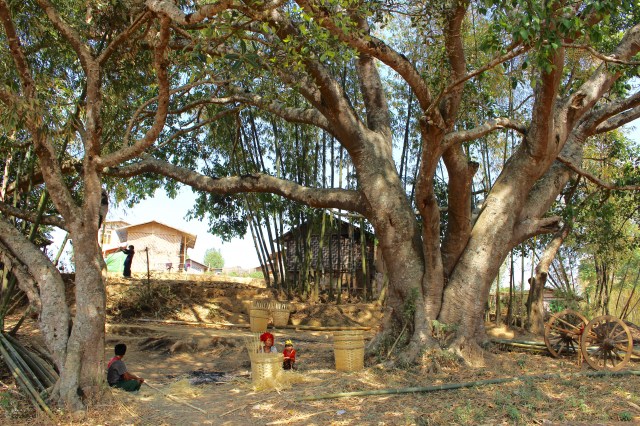
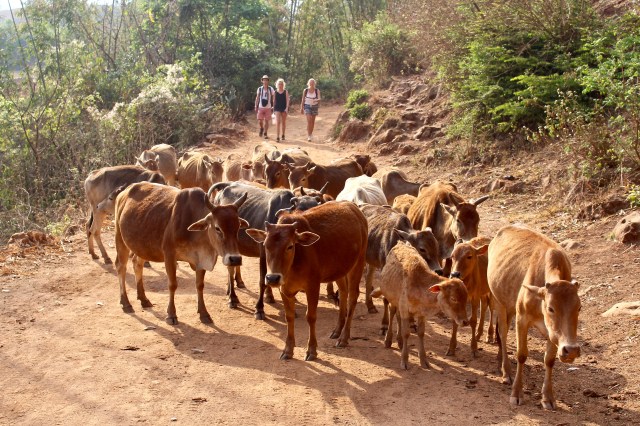
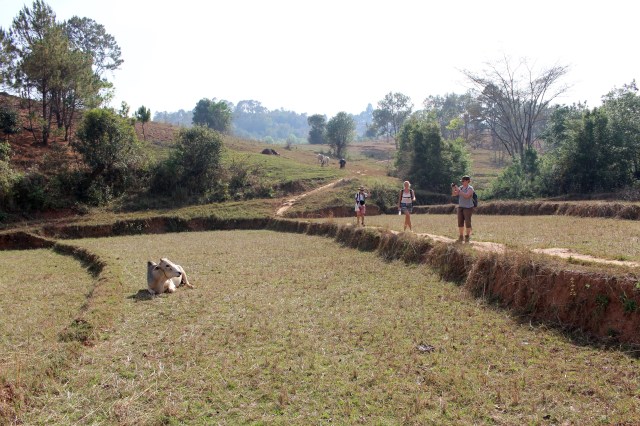
The terrain was primarily farm land, but much different than what Nebraska & Iowa offer. We walked along a tall ridge, each slope as far as the eye can see parceled out into different types of vegetation, and farmers out in the fields doing everything manually. We saw a lot of ginger, sweet potato, turmeric, and of course RICE on RICE on RICE on RICE. We saw men mining limestone to use for their betel chews. Along the way, our guide Ma le (sounded like “Molly”) would offer facts on what was growing, how things were planted, and other interesting tidbits on Burmese agricultural methods. Aleksiy stuck close to Ma le and asked a ton of questions, which the whole group was grateful for.
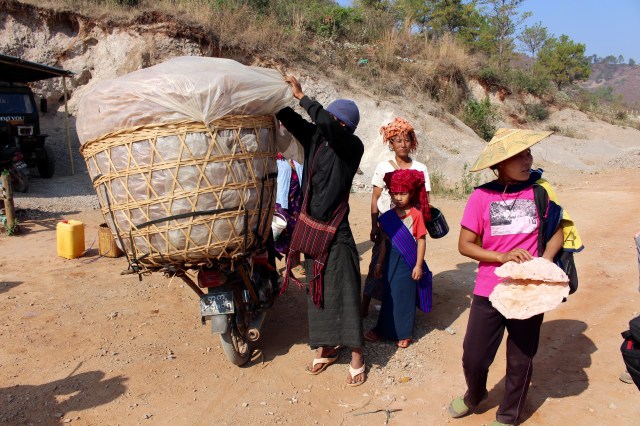
There were 8 of us in total, Anaroos and Denise, two fun and hilarious Dutch gals, whip-smart Canelle, a French resident of London, Eli, a cautious and mildly cynical internationally-raised American, and Ma le, our Pa-O (local tribe) guide. The group talked a lot as we marched on, the order naturally rotating so that everyone got to chat and get to know each other. That is, except Eli, who liked to hang back, “in case of a charging bull or snake or other sort of emergency it feels safer in the back.” It was really great to trek with such lovely humans, and I feel so lucky we had such a wonderful group.


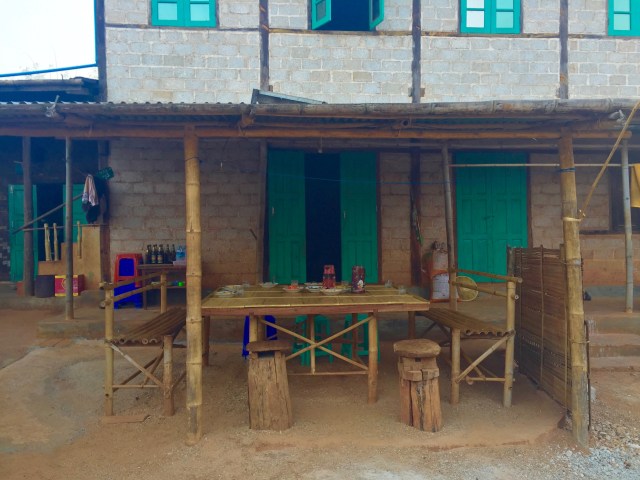
The homestay was interesting because we got to see first hand the economical impacts that trekking tourism has on an otherwise very traditional tribal community. We trekked past many villages with no running water, no electricity, everything as manual as it gets. (We saw men pounding cinder blocks into form, by hand, one by one.) When we arrived at our homestay, the town was booming. Every house had a larger guesthouse in some stage of development going up behind their original bamboo houses. Newly built outhouses and showers dotted side yards. They still didn’t have electricity, but our house had lightbulbs wired throughout which they connected to a car battery once it got dark. Kids were watching soccer games on their cell phones. Ma le told us that the trekking industry has brought these villages an amount of income they would have never been able to achieve via traditional agriculture, and the villagers are happy to welcome visitors.


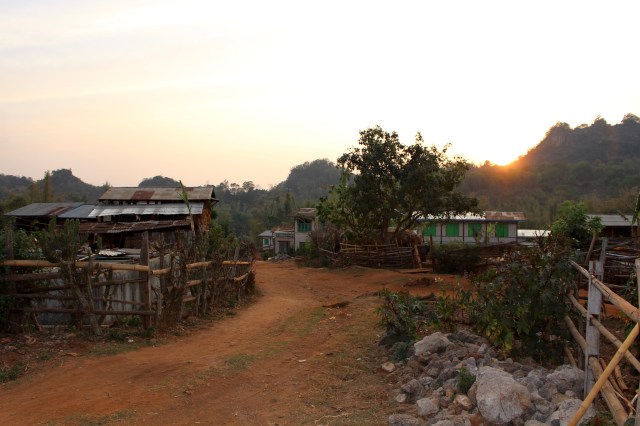
As we walked through the village before dinner her comments rang true, with cheerful greetings coming from the yards of our neighbors. Even so, I couldn’t help but worry about them – after hundreds of years of slow change and tribal living I fear the rapid onslaught of trekking groups will create some unintended side effects. That is all yet to be seen, but for now the trek –like Myanmar as a whole– is a wonderful and challenging adventure full of friendly locals eager to interact and share their culture.
 Tales of a Southeast Asian Invasion